

Last Updated: October 27, 2026
Quick Summary
The trending restaurant concepts for 2026 are narrow, problem-solving models: tiffin and Indian bowl concepts, value-driven fast casual, zero-proof and functional beverage bars, plus build-your-own formats, modular small plates, and beverage-and-snack concepts built around Gen Z preferences. Each succeeds through tighter menus and clearer positioning rather than trying to be everything to everyone.
- Value-driven fast casual sets a profitable price point first, then reverse-engineers a menu of roughly 12 to 18 SKUs to hit it.
- Value concepts should model unit economics at 10% below projected average check to confirm fixed costs are still covered.
- Zero-proof beverage bars need real technique and training investment, or guests won’t pay a premium.
- Bounded customization lets guests build meals while the kitchen preps components in batches and assembles to order.
- Test Gen Z-facing concepts by tracking repeat visits within 30 days and modifiers per ticket, not first-week volume.
Table of Contents
- The Restaurant Concepts Shaping 2026
- Restaurant Trends 2026: What the Demand Signals Show
- 1. Tiffin and Indian Bowl Concepts
- 2. Value-Driven Fast Casual
- 3. Zero-Proof and Functional Beverage Bars
- 2026 Food Trends Driving Menu Innovation
- Gen Z Food Trends and the Concepts Built Around Them
- Restaurant Concept Development: Matching a Trend to Your Market
- Frequently Asked Questions
The Restaurant Concepts Shaping 2026
The restaurant concepts gaining ground in 2026 share one trait: they solve a specific problem for a specific guest instead of trying to be everything to everyone. According to National Restaurant Association research on operator sentiment, operators continue to report pressure from food and labor costs, which pushes new concepts toward tighter menus and clearer positioning. This guide breaks down seven concept models, the demand signals behind them, and what each one demands operationally. Below, we rank them by commercial viability, not novelty. The list is short on purpose: most of these concepts succeed because they are narrow, not because they are trendy.
Restaurant Trends 2026: What the Demand Signals Show
Demand in 2026 favors concepts that reduce risk for the guest and the operator at the same time. Guests are trading down on price but not on experience, which is why value-driven formats and experience-led formats can both grow in the same market. Search interest and social media buzz remain useful early indicators, but they lag real consumer demand by months. That gap is where operators get burned. For a look at how last year’s signals matured, see our roundup of top food and restaurant trends in 2025, which tracks how momentum shifted year over year.
1. Tiffin and Indian Bowl Concepts
Tiffin and Indian bowl concepts package regional Indian cuisine into a fast-casual format built around assembly, not full-service cooking. The model works because Indian food already has strong consumer awareness, and a bowl format makes it portable, customizable, and easy to price. Menu innovation here is mostly about base-plus-protein-plus-garnish architecture, which keeps food costs visible and line speed high.
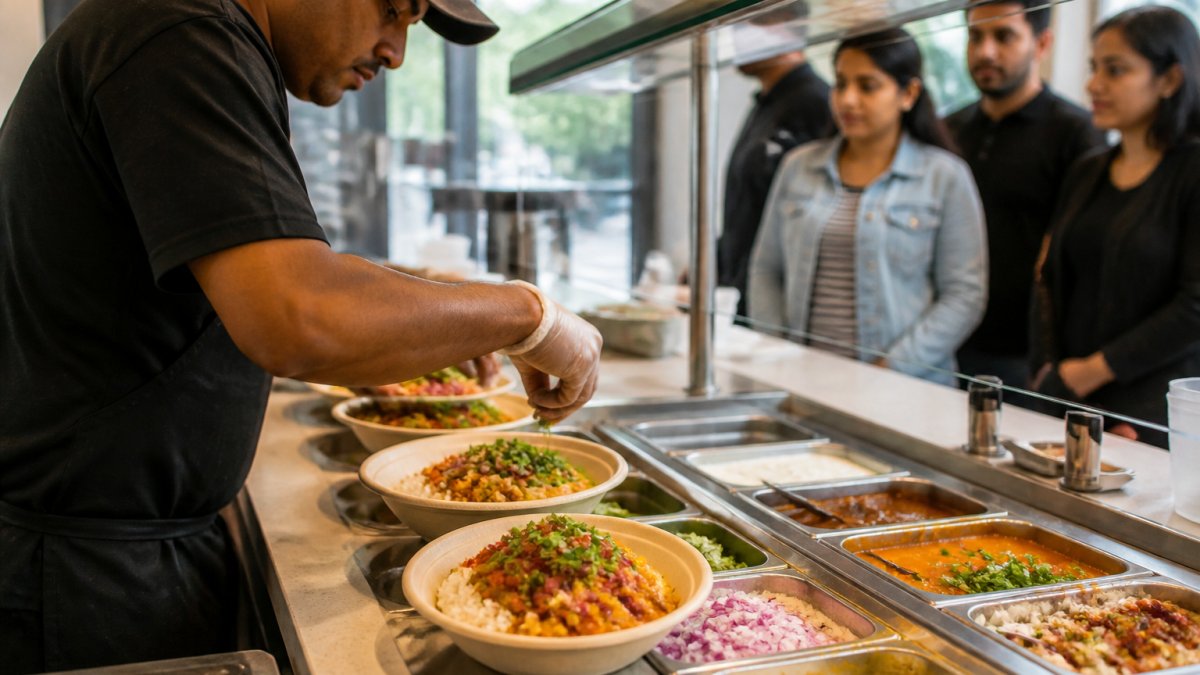
Operationally, these concepts live or die on prep. Curries and bases hold well, but the fresh garnishes and breads are where labor costs creep in. A common mistake is launching with a menu that is too broad; regional cuisines reward depth over breadth. Watch out: if your kitchen cannot batch bases consistently across shifts, ticket times and food cost variance will both climb.
2. Value-Driven Fast Casual
Value-driven fast casual is a concept built around a fixed, affordable price point rather than a discount strategy. The distinction matters. Discounts erode margin; a value architecture designs the menu so the target price is profitable from the start.
What separates a true value concept from a cheap one is the cost model underneath the price.
Menu engineering is the lever here. Place items by margin and popularity, then design combos that steer guests toward the high-margin anchors. The classic four-box analysis still applies: stars (high margin, high popularity) get prominent placement, plowhorses (high popularity, low margin) get reformulated or repriced, puzzles (high margin, low popularity) get repositioned or renamed, and dogs get cut.
The risk is value perception. If quality slips, the price advantage disappears and the guest does not come back. Value concepts have thinner buffers than full-service, so a single bad quarter of food cost variance can erase the model’s advantage.
Keep the menu tight, renegotiate procurement quarterly, and treat labor scheduling as part of the value equation, not an afterthought. Two operational tests separate durable value concepts from fragile ones. First, the rent-to-sales ratio: value concepts typically need to keep occupancy costs meaningfully below the industry norm because the price ceiling limits how much volume can absorb fixed costs. Second, seat turnover and daypart mix: a value concept that only fills lunch is a different business than one that carries dinner, and the labor schedule has to match. Before committing capital, run the concept through a simple stress test, model the unit economics at 10% below your projected average check and confirm the model still covers fixed costs. If it does not, the price point is aspirational, not architectural.
Audience fit matters as much as the math. Value fast casual tends to work best in trade areas with a dense daytime population, a strong takeout and delivery mix, and guests who prioritize speed and predictability over novelty.
3. Zero-Proof and Functional Beverage Bars
Zero-proof and functional beverage bars are concepts where the beverage program carries the margin and the identity. Mocktails, low-alcohol drinks, and functional beverages appeal to guests who want a social experience without alcohol, and the category keeps expanding as consumer preferences shift. Beverage-led concepts also open revenue streams that food-led concepts miss, including retail and restaurant convergence through bottled or canned products.
The operational catch is skill. A serious zero-proof program needs real technique, not just juice and soda, and that means training investment. For operators building this menu, our guide to profitable zero-proof cocktail strategies covers menu engineering and cost control for non-alcoholic programs. Watch out: if the drinks read as an afterthought next to the food, guests will not pay a premium for them.
2026 Food Trends Driving Menu Innovation
The 2026 food trends shaping menus cluster around three ideas: plant-forward dining, global flavors, and comfort food with a twist. Plant-forward options now function as a baseline expectation rather than a niche, and vegan options sit inside broader menus instead of separate sections. Global flavors keep pulling regional cuisines into mainstream formats, while comfort food delivers the sensory indulgence guests still want at a value price.
Limited-time menus remain the cheapest way to test these trends before committing capital. A short run of a new dish tells you more about real demand than any forecast. Operators can test whether a trend fits their kitchen’s labor model before adding it to a permanent menu.
Gen Z Food Trends and the Concepts Built Around Them
Gen Z food trends reward personalization, customization, and transparency over brand loyalty. This cohort grew up assembling their own meals and expects to modify a dish without friction. Concepts that build customization into the ordering flow, whether through build-your-own formats or modular menus, tend to convert this audience better than fixed-menu formats.
Three concept models consistently show up when operators build around this cohort. The first is the build-your-own bowl or plate format, where the guest assembles a meal from a base, a protein, and a set of toppings. The model works because the customization is real but bounded: the kitchen preps components in batches, the line assembles to order, and the guest perceives control without the operator absorbing the cost of true made-to-order cooking. The second is the modular small-plates or snack format, where guests order several smaller items and share, a structure that fits the cohort’s preference for variety and social dining.
The common thread is not the cuisine, it is bounded customization. The concept gives the guest meaningful choices inside a system the kitchen can execute at speed. Unbounded customization (endless modifiers, fully bespoke orders) is where these concepts break down operationally.
The trap is mistaking social media buzz for durable demand. A concept can trend online and still fail on unit economics. Testing a Gen Z-facing concept in a single location and measuring repeat visits, not first-week volume, can help operators assess it. A practical test: track the percentage of guests who return within 30 days and the average number of modifiers per ticket. High first-week volume with low repeat visits and a modifier count that slows the line is a warning sign, not a win. Technology-enabled dining, from ordering kiosks to AI-assisted personalization, helps here, but only when it reduces friction rather than adding a step, a kiosk that lets a guest customize without holding up the line is an asset; one that adds a screen between the guest and the food is a cost.
Audience and location fit deserve more attention than they usually get. Gen Z-facing concepts tend to perform best in trade areas with a high concentration of students, young professionals, or entertainment traffic, and they depend on a strong digital and delivery presence because this cohort discovers and orders through apps and social platforms. In suburban trade areas with an older guest base, the same concept may need a simplified menu and a stronger value message to translate.
Restaurant Concept Development: Matching a Trend to Your Market
Restaurant concept development is the discipline of matching a trend to a specific market, audience, and operating model before capital is committed. A concept that works in one trade area can fail in another for reasons that have nothing to do with the food. Feasibility studies, financial modeling, and site selection matter more than the trend itself.
This is where a structured approach pays off. Restaurant concept development can involve financial modeling, site selection, and menu design for operators launching or adapting a concept. If you are still weighing options, our guide on how to test a restaurant concept before opening walks through validation steps that cost far less than a failed build-out.
Three questions decide most concept decisions:
| Question | What to Measure | Why It Matters |
|---|---|---|
| Who is the core guest? | Repeat visit rate, daypart mix | Defines menu and price ceiling |
| Does the model fit the site? | Rent-to-sales ratio, seat turnover | Protects margin structure |
| Can the kitchen execute it? | Ticket time, prep labor hours | Determines consistency at scale |
TNI Restaurant Consultants has proprietary frameworks including Trend Mapping and the Zone of Purchase Acceptance. The work is unglamorous, and that is the point.
Frequently Asked Questions
What restaurant concepts are gaining popularity in 2026?
The models drawing the most operator attention are tiffin and Indian bowl formats, value-driven fast casual, zero-proof and functional beverage bars, plant-forward menus, and concepts built around customization. Each answers a specific consumer preference: affordability, convenience, dietary flexibility, or a social experience worth leaving home for. Before committing, test the concept against your local market’s demand signals rather than national averages, since a format that works in a dense urban trade area can stall in a suburban one.
How do Gen Z food trends differ from older diners’ preferences?
Gen Z food trends lean toward bold global flavors, customizable build-your-own formats, and drinks that photograph well, including zero-proof options. This group also weighs value perception heavily and researches a restaurant on social media before visiting. Operators targeting them should keep menu innovation fast, price entry points clear, and the visual presentation of both food and beverages deliberate. Older diners tend to reward comfort food and familiar regional cuisines, so a menu that serves both groups usually needs a clear core and a rotating edge.
How can restaurant operators decide whether a trend fits their concept?
Start with your existing guest base and unit economics. A trend fits when it lifts average check or frequency without adding labor hours or food cost you cannot recover. Map the trend against your kitchen capacity, supply chain, and price ceiling, then run it as a limited-time menu item before a permanent rollout. Structured restaurant concept development work can help operators assess whether a trend fits their concept.
How can restaurants turn a food trend into a profitable menu item?
Treat the trend as an ingredient or format, not the whole dish. Build it around components you already stock, price it to protect your target margin, and track its contribution margin separately for the first 60 days. Menu engineering can help assess whether the item earns its place or adds complexity. Limited-time menus can let operators measure demand before committing to equipment, training, or a permanent menu slot.
The gap between a trending concept and a profitable one is usually operational, not creative. If you are evaluating a concept for 2026, TNI Restaurant Consultants can pressure-test the model before you sign a lease. Our team brings concept development, financial modeling, and menu engineering together, backed by more than 89 new brands launched and over 800 openings or remodels. Get started with TNI Restaurant Consultants and build a concept grounded in commercial logic.
