


Restaurant Start Up Consulting & New Restaurant Development
From Restaurant Idea to Opening Day, and Beyond
Opening a restaurant is exciting, but it is also one of the most complex businesses an entrepreneur can attempt to create. A restaurant brings together real estate, construction, architecture, commercial kitchen design, food production, branding, marketing, technology, labor, finance, procurement, hospitality and operations under one roof. Each decision affects another, and many of the most expensive mistakes are made months before the first customer walks through the door.
TNI Restaurant Consultants helps restaurant entrepreneurs, developers, investors, hotel companies, chefs, restaurant groups and franchise organizations turn ideas into commercially viable restaurant businesses. Our team has developed, opened, remodeled and advised restaurant and hospitality concepts across the United States and in more than 20 countries, working with independent entrepreneurs, established restaurant companies, international hospitality organizations, franchise systems and emerging brands.
Restaurant Concept Development
Great restaurant concepts usually begin with an idea. Sometimes that idea is very clear, while in other cases it may be little more than a cuisine, a location, a chef, a piece of real estate or a belief that a certain type of restaurant should exist. Our restaurant concept development process gives that idea structure and tests it against both consumer relevance and operational reality.
TNI helps clients define the central proposition behind the restaurant: who it is for, what customer need it addresses, how it will compete, how guests should feel, what they should remember and why they should choose the restaurant rather than the alternatives available to them. That proposition then informs the menu, pricing, service model, branding, environment and economics.
Restaurant concept creation should not begin with a logo. It begins with a reason for the customer to choose you, and that reason needs to be strong enough to influence every major decision that follows.
Restaurant Market Positioning
One of the first questions we ask is deceptively simple: why this restaurant? Restaurant markets are crowded with good food, attractive interiors and competent operators, so being good is rarely enough to create enduring differentiation.
TNI evaluates the competitive market, customer expectations, pricing landscape, occasions, cuisine categories and existing restaurant propositions to determine where a genuine opportunity may exist. We consider the competitive set not simply in terms of cuisine, but in terms of the customer’s actual choice.
A customer deciding where to spend $35 on a Thursday evening may be comparing restaurants from entirely different categories. Understanding that wider competitive environment can materially influence restaurant positioning and often reveals that the true competitor is not the restaurant serving the same food, but the business competing for the same occasion, spend and customer attention.
Restaurant Feasibility Studies
Before significant capital is committed, the concept needs to be tested commercially. TNI restaurant feasibility work can examine market characteristics, competitive conditions, concept positioning, site factors, expected revenue, average check, capacity, labor requirements, food cost and operating assumptions.
The objective is not to manufacture a justification for opening. It is to determine whether the assumptions supporting the restaurant make sense and to identify which variables matter most. Sometimes the concept is viable but the proposed footprint is too large. Sometimes rent is the problem. Sometimes anticipated sales are unrealistic, or the menu cannot support the required average check.
Finding those issues before construction is considerably less expensive than discovering them after opening. A good feasibility process does not eliminate risk, but it makes the risk more visible and allows the client to make a better-informed investment decision.
Restaurant Business Plans
A useful restaurant business plan should function as a decision-making document rather than a collection of optimistic statements. TNI can develop restaurant business plans for owners, developers, investors, landlords, lenders and other stakeholders, with the structure tailored to the purpose of the project.
Depending upon the engagement, the plan may include the restaurant concept, market positioning, competitive landscape, target customer, operating model, menu direction, management structure, marketing strategy, development plan and financial projections. The strongest restaurant business plans connect the story of the concept with the mathematics of the operation, because the two should support one another. A compelling brand story without viable economics is not enough, just as a spreadsheet without a compelling customer proposition does not create demand. Both sides of the business have to work together.
Restaurant Financial Modeling
Ultimately, restaurants have to work financially. TNI develops restaurant financial models to test the commercial implications of the proposed concept and to make assumptions visible before capital is committed.
Depending upon the engagement, projections may include sales, transactions, average check, daypart mix, food and beverage mix, cost of goods, labor, occupancy costs, operating expenses and potential restaurant-level profitability. Scenario modeling can also evaluate the impact of changes in sales, pricing, labor, rent or food cost.
Instead of saying that a restaurant will be busy, we can ask how many transactions are required. Instead of saying the location is affordable, we can examine what level of revenue is necessary to support the occupancy cost. Instead of assuming that margins will be acceptable, we can test how the concept behaves under more conservative operating assumptions.
Financial modeling does not remove uncertainty, but it creates a much more disciplined basis for development.
Restaurant Startup Cost Planning
Restaurant startup costs can escalate quickly because capital is distributed across many categories. These may include deposits, professional fees, architecture, permits, construction, commercial kitchen equipment, furniture, fixtures, technology, smallwares, signage, opening inventory, recruitment, training, marketing and working capital.
TNI can help clients develop a more structured view of restaurant startup costs and identify areas where design or operating decisions materially affect the investment. One of the most important disciplines in restaurant development is protecting capital before opening because an additional dollar spent on something customers do not value is a dollar unavailable for something they may.
A realistic opening budget should therefore be tied to the concept, the site and the operating model rather than built around generic industry percentages.
Restaurant Menu Development
The menu sits at the intersection of customer demand and restaurant economics. It influences kitchen design, equipment, labor, procurement, storage, brand positioning, average check and guest perception, which is why TNI integrates restaurant menu development into the wider concept development process.
Our work may include menu strategy, category structure, product ideation, recipe development coordination, pricing strategy, product testing, cost analysis and menu engineering. The objective is to create food and beverage offerings that support both the brand promise and the operating model.
A menu should be exciting enough to create demand and disciplined enough to be executed consistently. More choice is not always better, and complexity that does not create customer value can create significant operating cost.
Menu Engineering & Menu Profitability
Not every popular item is profitable and not every profitable item deserves to remain on a menu. TNI can analyze menu contribution through food cost, selling price, product mix, contribution margin and operational complexity.
Menu engineering becomes particularly valuable when considered during restaurant development because decisions about ingredients, equipment and production methods can influence profitability before the kitchen is built. A menu with excessive SKU counts, too many cooking methods or poor ingredient crossover can create unnecessary inventory, labor and equipment requirements.
The best restaurant menu is not necessarily the largest. It is the menu that gives the customer sufficient choice while allowing the restaurant to execute consistently and profitably.
Restaurant Brand Development
A restaurant brand is considerably more than a logo. It is the collection of signals that tells customers what the restaurant represents and why it matters.
The name, menu language, design, music, service style, uniforms, packaging, photography and communications should feel as though they belong to the same idea. TNI helps clients develop restaurant brand personalities that connect the strategic proposition with the physical and operating experience.
Our process can include restaurant naming, positioning, narrative, personality, visual direction, customer proposition and coordination with branding specialists as required. Brand development should create recognition, but more importantly it should create meaning and a reason for customers to form an emotional and commercial relationship with the restaurant.
Restaurant Naming & Brand Personality
A restaurant name needs to work across multiple contexts. It has to sound right when spoken, look appropriate on signage, make sense digitally and support the personality of the concept. TNI assists with naming strategy and brand personality development as part of the wider restaurant concept development program; the goal is not simply to produce something clever. It is to create an identity capable of carrying the concept as it evolves and potentially expands.
Restaurant Architecture & Interior Design
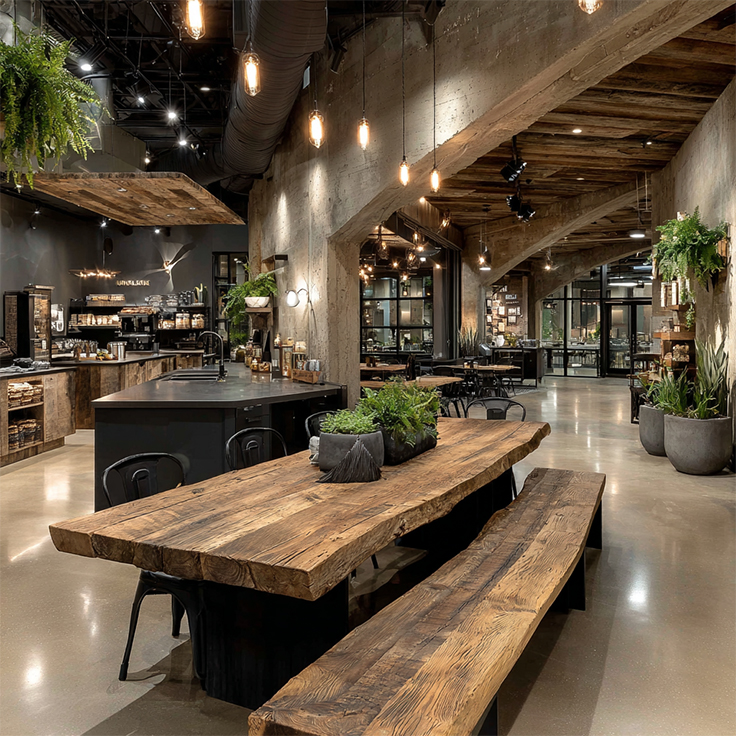
The restaurant environment is one of the most powerful ways to communicate the concept. Through TNI’s wider capabilities, restaurant consulting can be coordinated with restaurant architecture, interior design and commercial kitchen planning.
This creates a significant advantage during development because the space can be considered from both an operational and customer perspective. Seating capacity affects revenue, table configuration affects flexibility, kitchen location affects workflow, bar design affects throughput, lighting affects atmosphere and acoustics affect comfort. The design therefore becomes part of the business model rather than simply decoration. The strongest restaurant environments translate the concept into a physical experience while still supporting the economics and operational requirements of the business.
Restaurant Space Planning
Restaurant space planning determines how expensive square footage will be allocated between customer areas, kitchen, storage, bars, circulation, restrooms and support functions. TNI evaluates space planning against capacity, customer experience and operational requirements.
Adding more seats is not always the answer. A restaurant that seats more customers than its kitchen, bar or service team can effectively support may actually create a worse business. The objective is balance between revenue-producing areas, operational support and the guest experience, with every major area of the restaurant considered in relation to the whole.
Commercial Kitchen Design
The commercial kitchen is the production engine of the restaurant. TNI’s restaurant kitchen planning approach considers menu requirements, preparation, equipment, storage, refrigeration, warewashing, food flow, labor and production capacity. The kitchen should be designed around what the restaurant needs to produce at peak demand rather than around a generic equipment list. Poor commercial kitchen design creates labor inefficiency, bottlenecks and inconsistency that can continue for years, while good kitchen design makes the operation easier and more predictable.
Restaurant Equipment Planning
Commercial kitchen equipment represents a substantial portion of restaurant startup investment. TNI can help develop restaurant equipment requirements based on menu, production volume, space, utilities and budget.
The objective is to purchase the equipment the restaurant actually requires rather than filling the kitchen with equipment simply because it appears on a standard list. Equipment procurement and vendor coordination may also be supported depending upon project scope, helping to maintain alignment between the design intent and the operating model.
Restaurant Technology Planning
Restaurant technology has become part of the infrastructure of opening a restaurant. A modern restaurant may require POS, payment processing, Kitchen Display Systems, scheduling, inventory, accounting integrations, online ordering, delivery platforms, reservations, loyalty, CRM and reporting.
TNI helps restaurant startups evaluate technology from the perspective of the operation. We consider how information and orders should flow through the restaurant before selecting systems to support that flow. Technology should simplify restaurant operations rather than become another operational burden, and the technology stack should be considered as an integrated system rather than as a collection of independent applications.
POS & Restaurant Systems
Selecting a restaurant POS should begin with the operating model. The requirements of a QSR, fast-casual concept, fine-dining restaurant and multi-unit brand can be very different. TNI evaluates restaurant POS systems and related technology based upon functionality, integrations, cost, reporting, support and scalability. The right system is not necessarily the one with the longest feature list. It is the one that best supports how the restaurant intends to operate.
Restaurant Operating Systems
A restaurant cannot operate consistently on good intentions. Before opening, procedures need to be established for everything from ordering and inventory to cash controls, food safety, opening procedures, closing procedures, service recovery and management communication. TNI develops restaurant operating systems designed around the specific concept. These systems may include operating procedures, management routines, checklists, control processes, service standards and restaurant policies. The objective is to transform the idea behind the restaurant into repeatable operating behavior so that the customer experience does not depend entirely on individual memory or improvisation.
Restaurant SOP Development
Standard Operating Procedures provide the structure through which restaurant expectations become consistent actions. TNI can develop restaurant SOPs covering front-of-house, back-of-house and management operations. Procedures should be detailed enough to provide consistency without becoming so bureaucratic that employees stop using them. Good restaurant systems should make doing the right thing easier and should support the pace of a live hospitality operation rather than slow it down.
Restaurant Staffing & Recruitment Planning
Restaurants ultimately operate through people. TNI can help develop restaurant organization structures, staffing models, job descriptions, management structures and recruitment plans. Staffing requirements should be linked to sales expectations and the service model. Overstaffing can damage economics before the restaurant has established itself, while understaffing can damage the guest experience before the restaurant has established its reputation. The correct opening team therefore needs both operational capability and cultural alignment with the restaurant concept, particularly in management and guest-facing positions where early performance can influence the reputation of the brand.
Restaurant Training Programs
Training is one of the most underestimated elements of restaurant startup planning. A new restaurant brings together employees who may never have worked together, in a building they have never operated, using systems they have never used, to serve a menu they have never produced.
TNI develops restaurant training programs for management, front-of-house and back-of-house teams. Training may include product knowledge, service standards, operational procedures, customer care, management systems, food safety, opening and closing procedures and role-specific development.
The purpose is not simply to tell employees what to do. It is to create confidence, consistency and shared expectations before opening day.
Restaurant Pre-Opening Support
The final weeks before opening are among the most intense periods in restaurant development. Equipment arrives, technology is installed, employees are recruited, menus are finalized, vendors begin delivering, training starts, inspections take place and construction issues are resolved. TNI provides restaurant pre-opening support to coordinate the operational elements required to move from development into live operation. A structured restaurant opening plan helps identify dependencies and deadlines before they become emergencies and gives the opening team a clearer sequence of priorities.
Restaurant Opening Checklists
The number of tasks required to open a restaurant is substantial. TNI uses restaurant opening checklists and project management structures to track critical operational requirements across areas such as staffing, training, menu, purchasing, equipment, smallwares, technology, vendor setup, cleaning, inspections and opening inventory. The purpose is not to create paperwork. It is to reduce surprises and make sure that important operational requirements do not disappear between construction, design and opening activity.
Soft Openings & Restaurant Launches
Opening day should not be the first time the restaurant attempts to operate. Where appropriate, TNI can help develop soft-opening and trial-service strategies that allow teams to test systems, kitchen production, POS processes and guest flow before full commercial demand arrives.
These rehearsals often expose issues that are almost impossible to identify on a drawing or spreadsheet. Ticket routing may be wrong, a station may be missing equipment, the host process may become congested or the kitchen may struggle with a particular menu item. Finding those issues during controlled service creates an opportunity to correct them before they affect large numbers of paying customers and before poor first impressions become embedded in early reviews.
Post-Opening Restaurant Support
The work does not necessarily end when the doors open. The first weeks of restaurant operation generate valuable information about sales patterns, customer behavior, menu performance, labor requirements and operational bottlenecks.
TNI provides post-opening restaurant consulting to evaluate early performance and make adjustments while the business is still establishing its operating rhythm. The objective is to stabilize the operation quickly, protect the guest experience and help management distinguish between temporary opening issues and structural problems that require a more permanent response.
Restaurant Marketing & Launch Strategy
Opening a restaurant without a customer acquisition strategy can leave a well-developed operation waiting for demand to arrive. TNI can help align restaurant marketing and launch planning with the broader concept strategy. This may include target-customer definition, opening communications, local-area marketing, digital strategy, partnerships, community engagement, promotional planning and launch events. Marketing should communicate the restaurant proposition rather than simply announce that the restaurant exists.
The strongest launch strategies create awareness, but they also create context by helping potential customers understand what the restaurant is, who it is for and why it is relevant to them.
Vendor & Supply Chain Development
Restaurant startup planning also requires establishing a dependable network of suppliers. TNI can help identify and organize vendor requirements across food, beverage, equipment, operating supplies, linen, technology and other categories. Vendor selection should consider more than price. Reliability, product consistency, ordering procedures, delivery schedules, minimums, service and the ability to grow with the business can all influence the decision. A cheap supplier that fails during a peak period may ultimately be considerably more expensive than a slightly higher-cost supplier with dependable service and consistent product quality.
Restaurant Purchasing & Opening Inventory
Opening inventory requires discipline because new restaurants frequently over-purchase. TNI can help establish initial pars, purchasing procedures and opening inventory requirements.
The objective is to have sufficient product and supplies for opening without unnecessarily tying working capital up in excessive inventory. This is particularly important in food and beverage categories where over-ordering can lead directly to waste. Opening inventory should therefore be connected to the menu, anticipated sales and realistic ordering cycles rather than based on a desire to feel fully stocked.
Developing Scalable Restaurant Concepts
Many restaurant entrepreneurs are not simply opening one location. They are testing the first version of something they hope to expand.
That changes how the concept should be developed because menu complexity, equipment packages, restaurant footprints, operating systems, training, technology and brand standards all need to be considered with future replication in mind. A concept that depends entirely upon one exceptional chef or one unusual building may be difficult to replicate. If expansion is part of the ambition, scalability should become part of the original design criteria rather than something addressed only after the first unit succeeds.
Franchise Restaurant Development
Restaurant concepts intended for franchising require additional structure. Operational simplicity, documented standards, equipment consistency, training, unit economics and brand execution become increasingly important when the person operating the restaurant is no longer the founder.
TNI supports restaurant brands developing operating and design structures that support future multi-unit or franchise development. The focus is not simply on creating a restaurant that works once, but on creating a model that can be repeated with reasonable consistency across different operators and locations.
Supporting Restaurant Investors & Developers
Not every restaurant client is a restaurateur. TNI also works with property developers, investors, hospitality companies and owners who need restaurant expertise to assess or develop foodservice opportunities.
In these situations, our role may include concept strategy, operator evaluation, feasibility analysis, restaurant planning or development oversight. This can provide a commercial restaurant perspective before substantial capital is committed and can be particularly valuable where the restaurant is one component within a larger real estate, hotel or mixed-use development.
One Restaurant Development Partner
One of TNI’s strongest advantages is the breadth of disciplines that can be coordinated through the restaurant development process. A restaurant entrepreneur might otherwise need separate organizations for concept development, operations consulting, menu development, architecture, interior design, kitchen planning, technology, procurement and training.
Each specialist may perform excellent work while viewing the restaurant through a different lens. TNI’s model is designed to connect those decisions so that the menu can inform the kitchen, the kitchen can inform the architecture, the operating model can inform the technology, the financial model can inform the footprint and the brand can inform the environment.
That integration reduces the gap between what the restaurant was imagined to be and what eventually opens, which is one of the most common challenges in complex hospitality development.
Experience Matters When Opening a Restaurant
There is no single formula for creating a successful restaurant. If there were, restaurant development would be considerably easier.
Experience does, however, provide pattern recognition. After decades working across the restaurant and hospitality industry and developing concepts across more than 20 countries, TNI has seen ideas succeed, fail, evolve and occasionally become something significantly better than they were originally imagined to be. That experience allows our consultants to challenge assumptions while there is still time to change them. We can ask whether the menu is becoming too complex, whether the restaurant is too large, whether the kitchen is capable of supporting projected sales, whether pricing fits the market, whether labor assumptions are realistic, whether technology is helping or simply adding cost and whether the customer proposition is distinct enough.
These can be uncomfortable questions, but they are considerably more comfortable before opening than afterwards.
Who We Work With
TNI Restaurant Consultants works with first-time restaurant owners, experienced restaurateurs, chefs, investors, developers, hotel and resort companies, restaurant groups, franchise companies and international hospitality organizations.Some clients arrive with little more than an idea. Others have a site, financial backing and a well-developed concept but need assistance turning it into an operating restaurant. Others are experienced operators developing a new brand or entering a new market.
The starting point changes from project to project, but the objective remains consistent: build a concept capable of becoming a commercially sustainable restaurant business.
Restaurant Start Up Consulting FAQs
A restaurant startup consultant helps restaurant owners plan and develop the strategic, financial, operational and practical components required to create and open a restaurant. This can include concept development, feasibility, financial modeling, menu development, design, kitchen planning, technology, systems, staffing, training and opening support.
Ideally, restaurant consulting begins before major financial commitments are made. Early involvement allows the concept, site, menu, financial assumptions and operating model to be evaluated before expensive design and construction decisions become difficult to change.
Yes. TNI works with both experienced hospitality organizations and first-time restaurant entrepreneurs. For first-time owners, having a structured restaurant development process can be particularly valuable because many interdependent decisions have to be made simultaneously.
Yes. Restaurant concept development can begin with a cuisine, customer proposition, location, idea or investment thesis and progress through positioning, menu, branding, operating model, design and launch.
TNI’s team has developed, opened, remodeled and advised restaurant and hospitality concepts across more than 20 countries, providing exposure to a wide range of markets, operating models and consumer behaviors.
Yes. TNI can develop restaurant business plans incorporating concept strategy, market analysis, operating plans, development strategy and financial projections depending upon the requirements of the engagement.
Yes. Restaurant feasibility analysis can test assumptions around the market, concept, sales, pricing, costs, footprint, labor and other factors before substantial investment is committed.
Yes. Financial modeling can include sales, average check, transactions, food and beverage mix, cost of goods, labor, operating expenses and other restaurant-level assumptions.
Yes. TNI can help develop startup budgets covering relevant categories such as professional fees, design, construction, equipment, furniture, technology, opening inventory, recruitment, training and working capital.
Yes. TNI can assist with menu strategy, structure, product development, costing, pricing and menu engineering as part of restaurant concept development.
Restaurant design and architectural services can be coordinated through TNI’s wider capabilities, allowing restaurant consulting, space planning, kitchen planning and design decisions to be developed together.
Yes. TNI provides commercial kitchen design and foodservice planning based on menu requirements, workflow, equipment, production volume, storage and operational capacity.
Yes. TNI can assist with restaurant POS systems, KDS, inventory technology, labor systems, digital ordering and other elements of the restaurant technology stack.
Yes. Restaurant SOPs, policies, management systems, checklists and operating procedures can be developed around the requirements of the concept.
TNI can assist with organizational planning, job descriptions, staffing structures, recruitment strategy and restaurant training programs depending upon the project scope.
Restaurant pre-opening support coordinates the operational activities required before launch, including staffing, training, technology setup, purchasing, menu preparation, vendor coordination, opening inventory and trial operations.
A controlled soft opening can be extremely useful because it gives the restaurant an opportunity to test kitchen production, service, technology and operating procedures before facing full commercial demand.
Yes. Post-opening restaurant consulting can help evaluate early sales, labor, food cost, menu performance and operational issues and support the transition into a stable operating rhythm.
Yes. If expansion is an objective, the restaurant can be developed with greater consideration for repeatability, equipment standards, operating systems, training, economics and prototype requirements.
Restaurant development decisions are highly interconnected. TNI’s coordinated approach helps connect concept strategy, menu, economics, operations, kitchen planning, restaurant design, technology and opening support so that each discipline contributes to the same commercial objective.