

Table of Contents
- Assess Your Current Back of House Operations
- Optimize Restaurant Kitchen Workflow
- Implement Kitchen Display System Benefits
- Standardize Recipes and Prep with Templates
- Control Back of House Labor Costs
- Track Performance Metrics and Adjust
- Common Mistakes That Undermine BOH Efficiency
- Frequently Asked Questions
Last Updated: September 18, 2026
Assess Your Current Back of House Operations
The first step to improving back of house efficiency is understanding where you stand right now. Most restaurants operate without a clear baseline of what’s working, what’s costing money, or where bottlenecks exist.
Document your current workflow by walking through your kitchen during service, watching order flow, tracking prep time, and noting where staff wait or repeat steps.
Measure your prime costs (labor plus food costs). Calculate food cost percentage by dividing total food costs by revenue, and do the same for labor. Most restaurants run 55-65% combined; higher indicates inefficiency.
Calculate your inventory turnover rate weekly. Slow turnover signals waste, spoilage, and cash tied up in non-moving stock.
Talk to your team, kitchen staff, prep cooks, and servers, about what frustrates them and slows service. Front-of-house and back-of-house staff see problems differently; you need both perspectives.
Most restaurants skip this step and jump straight to solutions. Resist that urge. A solid baseline lets you measure whether changes actually work. Without it, you’re guessing.
Optimize Restaurant Kitchen Workflow
Kitchen layout determines execution speed. A poor layout forces unnecessary walking and equipment hunting; a smart layout reduces movement and creates clear task stations.
Organize prep stations by task: one for proteins, one for vegetables, one for sauces, one for plating. This prevents bottlenecks and focuses staff on speed and consistency.
Arrange equipment in the order cooks use it. Position sauté, sauce, and plating stations in a line to eliminate backtracking.
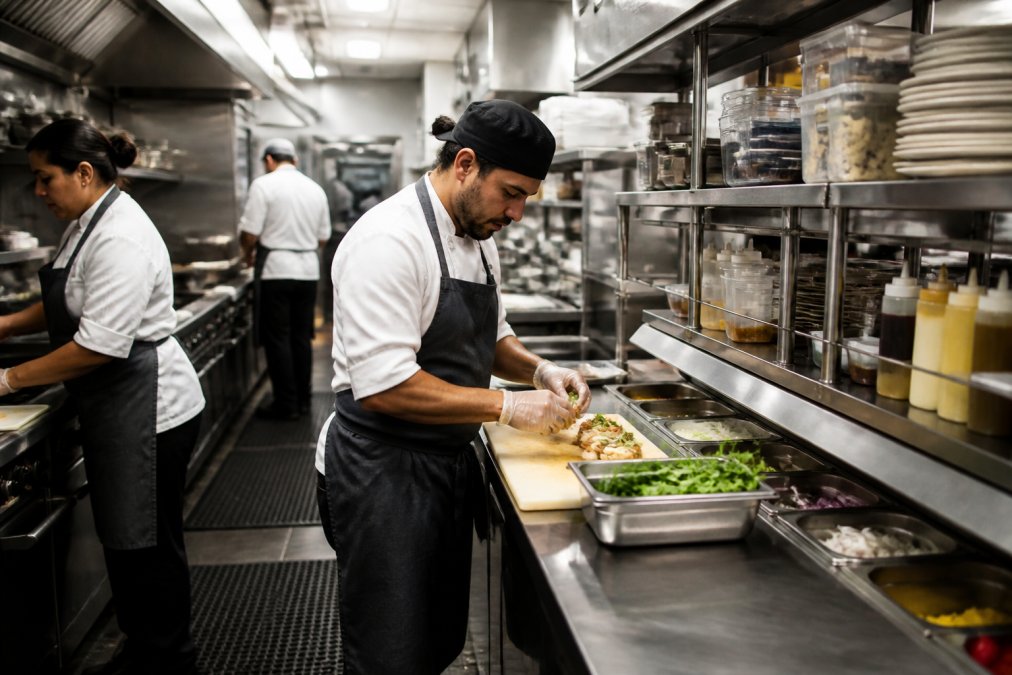
Create clear pathways between stations. Mark zones with tape if needed to eliminate clutter and safety hazards.
Standardize prep lists that specify what to prepare, quantities, and timing. This is foundational to back of house efficiency and prevents guesswork.
Track actual vs. theoretical food costs weekly. The gap reveals waste, over-portioning, or theft, one of the most powerful cost-control metrics.
A common mistake is over-complicating workflow. Cooks resist change. Keep improvements simple. One new station. One new process at a time. Test it for two weeks before adding more.
Implement Kitchen Display System Benefits
A kitchen display system (KDS) replaces paper tickets with a digital screen showing orders in real time, with massive operational impact.
A KDS eliminates handwriting errors and ensures clear, consistent orders.
The system prioritizes orders automatically, eliminating sequencing guesswork and cutting accuracy problems.
KDS software tracks timing, revealing which dishes slow service and which stations bottleneck, data that drives real improvements.
A KDS integrates with your POS system, eliminating miscommunication and handoff delays.
KDS reporting shows order volume, top sellers, and peak times, helping you forecast prep and schedule labor accurately.
The system reduces waste by cutting remakes and wrong plates.
A KDS is one of the highest-ROI investments you can make in back of house efficiency. It pays for itself through reduced errors and faster service within months.
Standardize Recipes and Prep with Templates
Standardized recipes are non-negotiable. Without them, consistency disappears, food costs vary, and quality suffers.
Create a recipe template for every dish with specific ingredients, quantities, cooking time, plating instructions, and portion size. “1/4 teaspoon of kosher salt” not “salt to taste.”
Build prep templates that specify dice size, oil type, and all other details. Remove ambiguity.
Test every recipe multiple times, timing and measuring portions until consistent. Then lock it in, no improvisation.
Photograph plated dishes and include photos in recipe templates. New cooks learn faster and consistency improves.
Post laminated recipes at each station for easy reference.
Update recipes when changed. Maintain one master version and share it with your entire team to prevent confusion.
| Step | Purpose | Frequency |
|---|---|---|
| Create recipe template | Define exact ingredients and technique | Once per dish |
| Test with team | Verify consistency and timing | 3-5 times |
| Photograph plating | Show visual standard | Once per dish |
| Post at stations | Enable quick reference | Daily |
| Update versions | Keep information current | As needed |
Control Back of House Labor Costs
Back of house labor runs 25-35% of revenue. The real challenge is maintaining efficiency with fewer, less experienced staff.
Adapt to Staffing Constraints
Food service turnover exceeds 150% annually. Many kitchens run with 20-30% fewer experienced staff than pre-2020 levels.
Redesign your kitchen around staffing reality. Simplify your menu, a 20-item menu requires less skill and coordination than 40 items. Review quarterly and cut items that don’t drive profit or require advanced technique. Menu Engineering can help identify which dishes truly drive profitability and which are dragging down your operation.
Automate high-skill tasks. Combi ovens, sous-vide, and blast chillers let new cooks execute consistent results and pay back through reduced labor hours and fewer mistakes.
Cross-train strategically. Identify bottleneck stations (usually sauté and grill) and train your best performers to cover both. Pair with a $1-2 per hour pay bump to incentivize retention.
Retain Your Best People
Replacing a cook costs 50-150% of their annual salary. Retention is cheaper than replacement.
Pay competitively. If you’re 10% below market, you’ll lose top people. A $2-3 per hour raise for top performers costs less than turnover.
Offer predictable schedules posted two weeks in advance. Predictability is often worth more to staff than extra pay.
Recognize performance publicly. This costs nothing, builds culture, and increases retention.
Create a clear advancement path from prep cook to line cook to sous chef. Define skills and timelines. Make it transparent.
Measure Labor Efficiency, Not Just Cost
Schedule labor based on POS forecasts. Monday needs fewer cooks than Friday; lunch differs from dinner.
Measure labor productivity by covers per labor hour. If one shift produces 35 vs. your 50-cover average, investigate bottlenecks.
Track labor hours against budget weekly. Distinguish between good increases (more covers) and bad ones (slow processes).
Reduce overtime ruthlessly. If consistent, your base staffing is too low or processes are too slow. Fix the root cause.
Build a Culture That Attracts Talent
Restaurants with clean kitchens, reasonable hours, and respectful treatment attract and retain better people. A calm kitchen with clear expectations retains staff; chaos burns through labor.
Invest in training. New cooks should shadow experienced ones for two weeks with written standards and recipes. Trained staff perform better and stay longer.
Address performance issues directly. Have a conversation, offer support, set clear expectations. If no improvement after 30 days, make a change. Tolerating poor performance breeds resentment.
In a tight labor market, efficiency isn’t just about squeezing more from your team, it’s about designing your kitchen to run well with the staff you can actually hire and retain. Simplify, automate, cross-train, and pay fairly. These moves cost less than constant turnover.
Track Performance Metrics and Adjust
What gets measured gets managed. Collecting data is worthless without interpretation and action.
The Core BOH Metrics
Calculate food cost percentage weekly: (Total Food Costs ÷ Revenue) × 100. Investigate upward trends immediately.
Track labor cost percentage weekly: (Total Labor Costs ÷ Revenue) × 100. A 1% increase on $100,000 revenue is $1,000 unbudgeted.
Track order accuracy daily. On 200 covers, 95% accuracy means 10 wrong plates, 10 remakes and wasted labor hours.
Track table turn time. If orders take 25 minutes instead of 18, table turns and revenue per seat drop.
Weigh food waste daily and track spoilage separately. Most restaurants waste 4-8%; reducing to 3% flows straight to profit.
Move Beyond Vanity Metrics to Strategic Insights
These five metrics are a baseline. The next level is using data to make menu and operational decisions.
Analyze Profitability by Dish
Not all menu items are equal. Some have high food cost and low price; others are labor-intensive or slow-selling.
Calculate actual profit margin for each dish, accounting for real waste, mistakes, and remakes, not just theoretical margin.
For each dish, track theoretical food cost, actual food cost, labor cost, sales volume, and remake rate. A 7-point gap between theoretical (28%) and actual (35%) is profit leaking, improve execution or raise price.
If a dish has >5% remake rate, it’s too complex or unclear. Simplify or remove it.
If a dish has low sales but high labor cost, remove it or simplify the recipe.
Use Peak-Time Data to Right-Size Your Menu
Use POS data on what sells and when to optimize your kitchen.
During peak service, if 8 of 15 entrées require sauté work, your sauté station bottlenecks. Orders back up and quality suffers.
If 60% of peak orders are three dishes, those three must be fast and simple. Complex dishes selling 2-3 times per peak aren’t worth kitchen real estate.
Consider a peak-time menu (6-8 p.m.) with 8-10 entrées instead of 15. Your kitchen runs faster, quality improves, and revenue per cover often increases.
Track Labor Productivity by Station
Not all labor hours are equal. Prep shifts differ from service shifts.
Calculate covers per labor hour by station.
Establish Benchmarks and Trend Them
Use Data to Pivot Your Menu Strategically
Metrics only matter if you act on them. If you track something and never discuss it, staff learns it doesn’t matter. Review metrics with your team every week. Talk about what changed and why. Celebrate wins. Problem-solve declines together.
Common Mistakes That Undermine BOH Efficiency
Many restaurants make the same efficiency mistakes repeatedly. Knowing them helps you avoid them.
Frequently Asked Questions
What does BOH mean in a restaurant?
BOH stands for back of house, which includes the kitchen, prep areas, storage, and all operational spaces where food is prepared and orders are fulfilled. It excludes the front of house (dining room and bar). Improving back of house efficiency directly impacts food quality, order accuracy, labor costs, and customer satisfaction.
How can standardized recipe templates improve kitchen productivity?
Standardized recipe templates ensure consistency in portion sizes, ingredient ratios, and prep methods across all shifts and staff. They reduce decision-making time, minimize waste from inconsistent portioning, and accelerate training for new team members. Templates also simplify inventory management and food cost analysis by establishing exact ingredient quantities.
What are the key metrics to measure back of house efficiency?
Track prime costs (food and labor combined), inventory turnover, actual versus theoretical food cost variance, order accuracy rates, prep station throughput, and labor hours per cover. These metrics reveal operational bottlenecks and show whether efficiency improvements are actually reducing costs or improving output.
How does kitchen layout impact overall restaurant efficiency?
Kitchen layout determines workflow, reduces wasted movement between stations, minimizes order fulfillment time, and affects staff safety and morale. A well-designed layout groups related tasks, positions high-volume stations centrally, and ensures clear communication lines. Poor layout creates congestion, slows service, and increases labor hours needed to complete the same output.