

Table of Contents
- Build a Restaurant Concept Validation Checklist Before You Spend a Dollar
- Define Your Minimum Viable Product for Restaurants
- How to Run a Restaurant Pop-Up That Actually Tests Demand
- Digital-Only Concept Testing: Validate Before You Cook
- Read the Metrics That Predict Unit Economics
- When Concept Testing Fails: What the Data Tells You
- Frequently Asked Questions
Last Updated: September 22, 2026
Build a Restaurant Concept Validation Checklist Before You Spend a Dollar
Testing a restaurant concept before opening means proving people will pay for your food, at your price, in your location, before you sign a lease. This guide from TNI Restaurant Consultants walks through the exact steps we use with founders, from a validation checklist to pop-up and digital-only testing.
Demographic and Psychographic Screening
Demographics tell you who lives nearby. Psychographics tell you how they eat.
Screen for both:
- Who is within a 10-minute drive or walk?
- How often do they eat out, and at what price point?
- What cuisines already sell well in this trade area?
Financial Red Flags in the Checklist
Your checklist should flag numbers that don’t work before you sign anything:
- Food cost that leaves no room for labor and rent
- A target average check the local market won’t support
- Rent that pushes break-even above realistic table turns
- A menu too large for a small opening team
Define Your Minimum Viable Product for Restaurants
A minimum viable product for restaurants is the smallest version of your concept that still proves demand: a limited menu, a simple setup, and a clear way to measure whether guests come back.
Micro-Menu Design for Fast Feedback
A micro-menu is a short, focused menu built to test your best ideas fast. Keep it to five to eight items that represent your concept’s identity.
Why it works:
- Lower food cost and less waste
- Faster kitchen execution with fewer errors
- Clear signal on which items drive repeat visits
How to Run a Restaurant Pop-Up That Actually Tests Demand
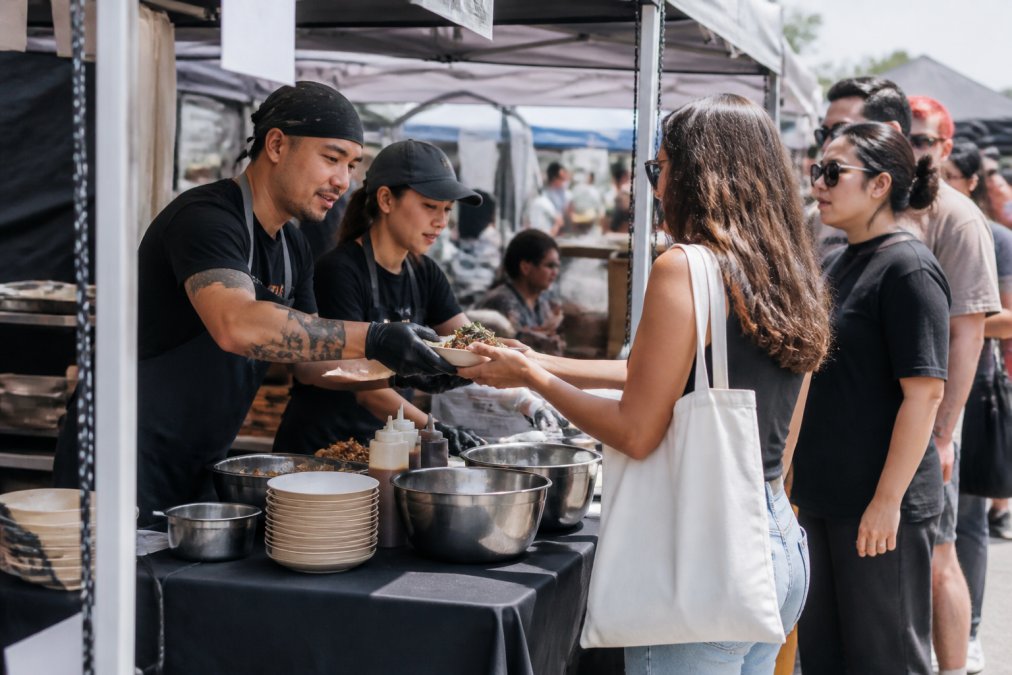
A restaurant pop-up is a short-term service in a temporary space, the closest thing to a real opening without the lease. You get real guests, real tickets, and real feedback.
Design the Pop-Up as a Controlled Experiment
Before you book anything, write down what you’re testing. A pop-up that tests everything tests nothing.
Pick one or two variables per event:
- Menu fit, Do guests order the items you expect them to order, or do they gravitate to something else?
- Price tolerance, Will they pay your target average check without a discount?
- Service model, Counter vs. table service, and how that changes ticket time and labor.
- Daypart, Lunch vs. dinner demand for your concept in this trade area.
Permits and Legal Requirements for Pop-Ups
Pop-up rules vary by state and city, so check local requirements before you book a space. Most jurisdictions require food handler certification, a temporary food service permit, and a health inspection, the step most first-time operators underestimate, and the one that can cancel an event the week of.
A few things to confirm early:
- Temporary food service permit from your local health department, often called a Temporary Food Establishment (TFE) permit. Application windows are typically 10-30 days before the event, and some jurisdictions require the permit to be posted on site.
- Food handler cards for anyone touching food. Many states accept an accredited online course; check whether your state requires a specific ANSI-accredited provider.
- Certified Food Protection Manager on site if your jurisdiction requires it for temporary events. This is separate from a food handler card.
- Proper handwashing and cold storage on site, a handwash station with warm water, soap, and paper towels, plus a calibrated thermometer and cold holding at 41°F or below.
- Business license or vendor permit for the event, sometimes issued by the city rather than the health department.
- Liability insurance, often required by the venue. General liability plus liquor liability if you’re serving alcohol.
- Fire and electrical approval if you’re using propane, generators, or fryers under a tent.
What to Measure During the Pop-Up
Treat the event like a soft opening with a scorecard. Track per service:
|
Metric |
Why It Matters |
|---|---|
|
Covers served |
Demand signal for the concept |
|
Average check |
Whether your price point holds |
|
Ticket time (order to plate) |
Kitchen flow under real pressure |
|
Top 3 and bottom 3 sellers |
Menu engineering input |
|
Repeat guests within the event |
Early loyalty signal |
|
Walk-aways (line too long, sold out) |
Lost demand you can capture next time |
Where Pop-Ups Fit in the Validation Sequence
A pop-up is a mid-stage test, not a first test. Run it after screening demographics and psychographics and after validating price tolerance with a digital test. Use it to confirm that online demand converts to real covers and real dollars.
Digital-Only Concept Testing: Validate Before You Cook
Digital-only testing validates demand without cooking a single plate. You test the concept through menus, photos, and ads before spending on food or space. It’s the cheapest test in the validation sequence, and the one most founders skip because it feels less exciting than a pop-up.
Build the Test Asset
You don’t need a website, just a single page that shows the concept, the menu, the price, and asks for a commitment.
- Concept line, one sentence that names the cuisine, the format, and the occasion. “Wood-fired Neapolitan pizza, counter service, weeknight dinner.”
- Menu, 5-8 items with real names and real prices. No placeholders.
- Hero image, one strong food photo. Stock photos underperform real ones, but a real one beats no image.
- Call to action, a reservation deposit, an email signup for a “founders list,” or a pre-order. An email signup is the lowest-friction ask; a deposit is the strongest signal.
Run the Ads Like a Media Buyer
Run small, local, tightly targeted ads on Meta (Facebook and Instagram) and Google. Keep the budget small, $200-$500 per test reads a signal in most markets. Set up:
- Geography, a radius around your target trade area, not the whole metro.
- Audience, start broad and let the platform optimize. Interest stacking usually narrows reach without improving signal.
- Creative, two or three ad variations with different menu names, prices, or positioning.
- Objective, traffic or leads, not awareness. You want a measurable action.
Read the Metrics That Matter
Vanity metrics (impressions, likes) tell you nothing. Track:
|
Metric |
What It Tells You |
Rough Signal |
|---|---|---|
|
Click-through rate (CTR) |
Whether the concept stops the scroll |
1%+ is workable; under 0.5% means the hook is weak |
|
Cost per click (CPC) |
Efficiency of the ad |
Varies by market; compare versions, not absolutes |
|
Landing page conversion rate |
Whether the page closes the click |
5-15% for email signup; 1-3% for a deposit |
|
Cost per lead |
What a warm prospect costs |
Lower is better; track trend across versions |
|
Signup-to-show rate (if you host a tasting) |
Whether interest is real |
A common pattern is 30-50% |
Run the test at least 7-10 days before reading results. Small samples lie.
The Delivery-Only Variant
If your concept can travel, test it through a ghost kitchen or delivery-only menu without a dining room. This is the closest digital test to a real transaction because guests actually pay for food.
- List on major third-party delivery platforms under a test brand name.
- Keep the menu to 5-8 items that travel well.
- Watch order volume, repeat orders, and ratings over 30 days.
- Compare food cost against platform commissions, typically 15-30% of the ticket.
What Digital Testing Can’t Tell You
Digital tests measure intent, not experience. A high signup rate doesn’t mean guests will like the food, and a low one doesn’t always mean the concept is bad, the ad creative or audience may be wrong.
Read the Metrics That Predict Unit Economics
Unit economics tell you whether one location can make money. The metrics you collect during testing predict whether the model works at scale. Focus on:
|
Metric |
What It Tells You |
Target Signal |
|---|---|---|
|
Average check |
What guests actually spend |
Meets or beats your model |
|
Food cost % |
Margin on each plate |
Leaves room for labor and rent |
|
Table turns |
Revenue per seat per night |
Supports your break-even |
|
Repeat rate |
Whether guests come back |
Steady return visits |
|
Labor load |
Staffing needed per cover |
Fits your service model |
When Concept Testing Fails: What the Data Tells You
Concept testing fails when the data says no and the founder opens anyway. That’s the real failure, not a bad test result. Common patterns:
- Strong first-week sales, then a sharp drop with no repeat guests
- Good feedback on food, weak feedback on price
- High interest online, low turnout in person
- A menu that guests describe as confusing or unfocused
Frequently Asked Questions
What is the 30/30/30 rule for restaurants?
The 30/30/30 rule allocates 30% of revenue to food cost, 30% to labor, and 30% to occupancy and operating expenses, leaving roughly 10% for profit. Use it as a screening tool during concept testing: if your micro-menu’s food cost creeps above 30% at realistic volume, the concept needs rework before you sign a lease. TNI Restaurant Consultants’ financial modeling services help operators pressure-test these ratios against actual pop-up data.
How do I conduct market research for a new dining concept?
Start with demographic and psychographic analysis of your target trade area, then layer in competitive mapping and demand signals. Run a small pop-up or ghost kitchen test to gather quantitative data (average check, table turns) and qualitative feedback (customer preferences, brand perception). TNI Restaurant Consultants uses proprietary tools like the Zone of Purchase Acceptance (ZOPA) and Trend Mapping to calibrate positioning before capital is committed.
What is a Minimum Viable Product (MVP) in the context of a restaurant?
A restaurant MVP is a stripped-down version of your concept: a micro-menu of 6-10 items, a single service format, and a temporary location (pop-up, food truck, or shared kitchen). The goal is to test demand, pricing, and operational flow with minimal capital. If the MVP hits target food cost, labor load, and average check, you have evidence to scale. If not, you iterate cheaply before signing a long-term lease.
How can I use a pop-up event to validate my menu?
A pop-up event lets you test menu items in a real service environment without a permanent buildout. Track sell-through rates per item, average check, and customer feedback on taste and portion size. Use a micro-menu to keep prep simple and gather clean data. Legal requirements vary by state and county, so confirm temporary food permits, health department rules, and any local zoning before you announce the event.