

Franchising can be one of the most effective ways to grow a restaurant or hospitality brand. It can also be one of the fastest ways to expose weaknesses that were largely invisible when the business consisted of one or two founder-operated locations. That distinction matters.
A successful restaurant is not necessarily a franchise-ready restaurant. The first proves that a concept can work. The second requires proof that the concept can be replicated by somebody else, in another building, with another team, under different market conditions, while still delivering acceptable economics and a recognizable guest experience.
That is a considerably higher standard. After decades working across restaurant operations, concept development, architecture, design and multi-unit growth, I have come to view franchise risk differently. Most franchise failures are rarely attributable to one spectacular mistake. More often, risk accumulates through dozens of smaller decisions: a kitchen that requires too much labor, a prototype that costs too much to build, recipes that depend on highly skilled employees, equipment that is difficult to service, weak purchasing controls, inconsistent training, an unsuitable site or unit economics that leave too little room for error.
Individually, these problems may appear manageable. Replicated across 20, 50 or 100 restaurants, they become structural.
The objective of reduced-risk hospitality franchise development, therefore, is not to eliminate risk. That would be unrealistic. It is to identify where risk resides in the business and engineer as much of it as practical out of the model before scale magnifies it.
The First Restaurant and the Fiftieth Restaurant Are Different Problems
Founders understandably focus on whether customers like the concept. Franchise development requires another question: Can the organization reproduce the reasons customers like it?
This is where many otherwise attractive concepts encounter difficulty. The original restaurant may benefit from an exceptional founder, chef or general manager. Its location may be unusually favorable. The kitchen team may have developed informal workarounds that compensate for inefficient design. Managers may know how to order inventory because they have been doing it for years. Recipes may live partly in people’s heads. Problems are solved through experience rather than systems.
That can work extremely well in an individual restaurant. It is a dangerous foundation for a franchise; the franchisee does not inherit the founder’s intuition. They inherit the system. That makes franchise development fundamentally an exercise in codification. The brand has to translate knowledge, culture, product, service and economics into something another operator can understand and reproduce. This is why I believe franchise risk begins considerably earlier than the franchise agreement, it begins with the architecture of the business itself.
Risk Is Multiplied by Replication
A restaurant operating one location has one set of operational variables. A franchise system operating dozens of locations has those same variables multiplied across different owners, employees, buildings, jurisdictions, suppliers and markets.
Food cost is one example. A few percentage points of unexplained food-cost variance in one restaurant deserves attention. Across a large franchise network, the same variance can represent substantial economic leakage. More importantly, it may indicate something deeper: portion inconsistency, purchasing problems, waste, theft, incorrect recipe specifications, pricing weakness or poor inventory controls.
Labor behaves similarly; an inefficient workstation might add only seconds to an individual transaction. Across hundreds of transactions each day, thousands of operating days and eventually dozens of restaurants, those seconds become labor hours.
This is an important principle of franchise development: Scale does not only multiply success, It multiplies inefficiency, consequently, the best time to remove unnecessary complexity is before expansion rather than after it.
Start With Unit Economics, Not Franchise Sales
The attraction of franchising is understandable. Franchisees provide capital, development accelerates and the brand gains geographic reach without funding every restaurant itself. But selling franchises before fully understanding restaurant-level economics simply transfers uncertainty into the network.
Before expansion, management should understand what a representative restaurant is genuinely capable of producing. That analysis should include realistic development cost, occupancy, food and beverage cost, labor, management, utilities, repairs and maintenance, technology, royalties, marketing contributions and other recurring expenses.
Sensitivity analysis is equally important. What happens if construction costs increase 10%? What happens if sales are 15% below forecast? What happens if labor rises? What happens if the opening is delayed three months? What happens when commodity prices move unexpectedly? A franchise model that works only when everything goes according to plan is not particularly resilient.
This is where development strategy and operational strategy have to meet. The objective is not simply to demonstrate attractive returns. It is to understand the operating envelope within which the franchise remains viable.
Design Is a Financial Control
Restaurant design is too often treated as an aesthetic exercise followed by an operational review. For scalable hospitality concepts, I would reverse that logic; Design is part of the operating system.
The distance between refrigeration and the cookline affects labor. Storage capacity affects purchasing frequency and inventory. Equipment selection affects throughput, maintenance and training. The position of the pass affects communication between kitchen and service teams. Poor circulation creates collisions and wasted movement. Insufficient electrical, plumbing or mechanical capacity can become extremely expensive once construction has begun.
These are design decisions, but they are also financial decisions. This becomes even more important in franchise development because a prototype will potentially be reproduced many times. An inefficient detail repeated once is an inconvenience. Repeated across 100 restaurants, it becomes an expensive corporate decision.
At TNI, this is one reason we look at architecture, kitchen planning and operations as interconnected disciplines rather than separate assignments. A franchise prototype should answer a simple question: Does the physical environment make the desired operation easier to execute? If it does not, the design is working against the brand.
Design Out Complexity Before Writing the Operations Manual
There is a tendency in franchise development to document complexity rather than eliminate it. A complicated process receives a complicated SOP. A difficult recipe receives additional training. A badly positioned workstation receives another procedure, therefore sometimes the better answer is to redesign the process.
Every unnecessary movement, decision, ingredient, piece of equipment or exception introduces another potential point of failure. The objective is not to make a restaurant simplistic. It is to make execution intuitive. That distinction becomes enormously important when employee turnover, different skill levels and varying management experience are introduced into a franchise system. The best operating systems reduce the number of opportunities employees have to make the wrong decision.
Standardization Without Sterilization
Standardization is essential to franchising, but it is frequently misunderstood. The objective is not to make every restaurant feel mechanical. It is to protect the elements of the experience that define the brand while giving operators a clear framework within which to perform. Certain elements should generally have very little variation: recipes, food-safety procedures, core equipment, technology infrastructure, purchasing standards, brand identity and key operating processes.
Other elements may appropriately respond to local markets, real estate and customer behavior. The strategic question is therefore not whether to standardize. It is what requires standardization and where controlled flexibility creates value; strong franchise systems understand that distinction.
Compliance Should Be Designed Into the System
Compliance becomes progressively more complex as restaurant brands cross cities, counties and states. Accessibility, building codes, food safety, employment practices, liquor licensing, fire requirements and health regulations can all vary by jurisdiction. The answer is not to assume that one prototype can simply be dropped into every market. Instead, the prototype should establish a strong baseline while the development process includes jurisdiction-specific review. The same principle applies operationally. Food-safety documentation, employee certifications, inspection records, incident reporting, insurance requirements and training should form part of the operating infrastructure rather than being assembled when an inspection or problem occurs. Compliance works best when it becomes routine.
Supply Chains Need Redundancy
A franchise system is only as dependable as the infrastructure supplying it.
Single-source dependencies can create vulnerability, particularly when a proprietary product has no practical substitute. Conversely, excessive purchasing freedom can dilute quality and reduce the economic benefits of aggregated buying. The appropriate balance depends on the concept. Critical ingredients should be mapped according to availability, lead time, substitution options and impact on the guest experience. Where practical, secondary suppliers should be qualified before they are required rather than during an emergency. Inventory systems should similarly move the organization away from intuition toward visibility.
The objective is straightforward: management should know what the restaurants are using, what they are wasting, what they are paying and where unusual variances are occurring.
Training Is Risk Management
Training is frequently discussed as an HR function. In a franchise organization, it is much broader, training protects product consistency, food safety, service standards, labor productivity and brand reputation. More importantly, training converts the franchise system from a collection of documents into repeatable human behavior. An operations manual sitting on a shelf creates little value. Systems become valuable when people understand them, practice them and are measured against them.
Training should therefore begin before opening and continue afterward. New products, new technology, employee turnover and operational changes continually create new training requirements. A franchise system is never permanently trained.
Crisis Planning Before the Crisis
Every hospitality organization eventually encounters unexpected events. A guest becomes ill. An employee is injured. Refrigeration fails. A social-media complaint accelerates. A supplier recall occurs. A regulatory issue develops. The quality of the response often depends on decisions made long before the incident. Franchisees should know whom to contact, what information to preserve, when insurers or professional advisers need to become involved, who is authorized to communicate externally and how incidents should be documented.
This is particularly important in a franchise environment because one local incident can rapidly become associated with the national brand. A crisis protocol therefore should not be a document written after the first crisis. It is part of the franchise operating system.
The Reduced Risk Franchise Framework
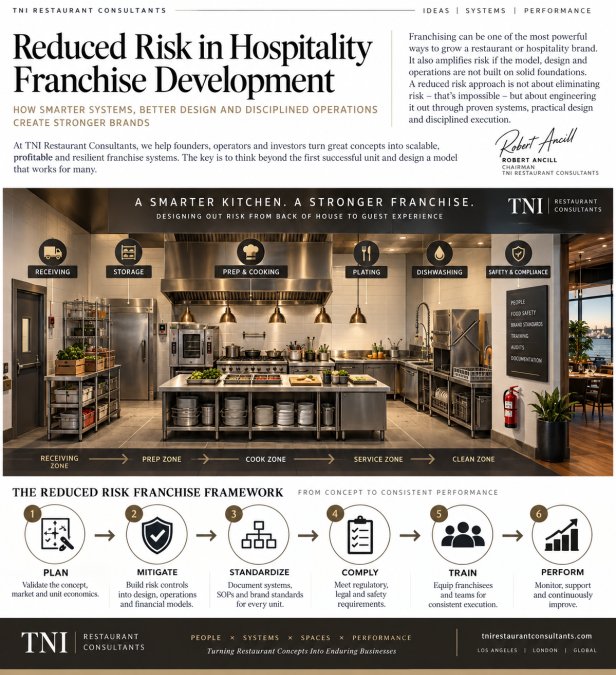
At TNI Restaurant Consultants, I increasingly think about franchise development through six connected disciplines: Plan, Mitigate, Standardize, Comply, Train and Perform.
Plan means establishing whether the concept, market, development economics and operating model justify replication.
Mitigate means identifying financial, operational, design, supply-chain and human risks before they become embedded in the system.
Standardize means converting successful practices into documented specifications, operating procedures and brand standards.
Comply means integrating regulatory, food-safety, accessibility and employment requirements into development and operations.
Train means transferring the system to franchisees, managers and employees in a way that can actually be executed.
Perform means measuring what happens after opening and continuously improving the model.
Importantly, this is not a linear process that ends when a restaurant opens. Performance data should flow back into planning. A recurring equipment failure may change the prototype. Labor data may change kitchen configuration. Customer behavior may change menu architecture. Construction experience may alter material specifications. The franchise system should become more intelligent with every restaurant it opens.
The Real Objective: A Business That Can Survive Imperfection
There is a temptation when developing franchise systems to design around the ideal restaurant: the ideal franchisee, ideal location, ideal employees and ideal sales volume, however real businesses rarely operate under ideal conditions.
Employees call in sick. Managers leave. Commodity prices rise. Equipment breaks. Construction is delayed. Customer behavior changes. A location performs below forecast. A resilient franchise model anticipates a reasonable degree of imperfection which is ultimately what reduced-risk franchise development means to me.
It is not the absence of risk. It is the deliberate construction of a business capable of absorbing normal operational shocks without losing its economics, standards or identity. The strongest franchise brands are therefore rarely those with the thickest operations manuals. They are the businesses in which people, systems, spaces and economics have been designed to work together.
Frequently Asked Questions
What does reduced-risk hospitality franchise development mean?
Reduced-risk franchise development is the process of identifying and reducing avoidable financial, operational, design, compliance and supply-chain risks before a restaurant or hospitality concept is widely replicated. It does not imply that franchising can become risk-free; rather, it seeks to create a more resilient and repeatable operating model.
When is a restaurant ready to franchise?
A restaurant may be commercially successful without being franchise-ready. Franchise readiness requires demonstrable unit economics, documented operating systems, repeatable recipes and service standards, appropriate training infrastructure, a replicable physical prototype and sufficient organizational capability to support franchisees after opening.
What role does standardized design play in reducing liability and operational risk?
Standardized hospitality design reduces liability by ensuring consistent safety protocols, ADA compliance, and emergency response procedures across all units. Uniform kitchen layouts, workstation ergonomics, and traffic flow patterns minimize staff injury and customer incidents. Standardized design also accelerates training, improves operational efficiency, and maintains brand consistency. Design standards that address post-pandemic supply chain resilience—modular layouts, flexible service models, and technology integration—protect against future disruptions. Compliance with building codes, health department regulations, and food safety standards is embedded in the design template.
What are the biggest risks in restaurant franchising?
Common risks include unrealistic unit economics, excessive construction costs, poor site selection, inconsistent operations, inadequate training, food-safety failures, labor inefficiency, weak supply-chain infrastructure, unsuitable franchisees and loss of brand consistency as the system grows.
How can restaurant design reduce franchise risk?
Good restaurant and commercial kitchen design can improve workflow, throughput, visibility, storage, food safety and labor productivity while reducing unnecessary movement and operational complexity. For franchise systems, these improvements become particularly valuable because successful design decisions can be replicated throughout the network.
Why are restaurant unit economics important before franchising?
Franchisees need sufficient restaurant-level cash flow to operate the business, service obligations, reinvest in the asset and withstand normal fluctuations in sales and costs. Understanding unit economics before aggressive expansion helps determine whether the underlying business model remains viable under realistic operating conditions.
How important are SOPs in restaurant franchise development?
Standard operating procedures are fundamental because they transfer knowledge from the original operator to franchisees and their teams. However, documentation alone is insufficient. Effective SOPs should be practical, trainable, measurable and supported by systems that make compliance relatively easy.
Should every franchised restaurant have exactly the same design?
Not necessarily. Core brand standards, operational relationships, kitchen requirements and critical equipment can be standardized while individual buildings and markets require adaptation. A strong prototype establishes what cannot change, what can change and the parameters governing those variations.
How does supply-chain planning reduce restaurant franchise risk?
Supply-chain planning helps protect product availability, pricing and consistency. Approved suppliers, alternative sourcing strategies, inventory visibility and clear product specifications can reduce the impact of shortages, unexpected price changes and supplier disruption.
Why should franchise training continue after opening?
Restaurant operations continually change through employee turnover, menu development, technology, regulation and customer expectations. Continuing education and operational support help franchisees maintain standards and allow lessons from individual restaurants to be transferred across the broader franchise system.
What should a restaurant company do before beginning franchise expansion?
Before substantial franchise development, leadership should pressure-test the concept's unit economics, operating procedures, restaurant prototype, kitchen workflow, supply chain, technology, training program, compliance processes and franchisee-support infrastructure. The central question is whether the success of the original operation has been converted into a system that another competent operator can reproduce.