

Cross-Atlantic Strategies for Growth in 2026 and Beyond
 As the hospitality sector enters its next evolutionary phase, operators on both sides of the Atlantic face a shared challenge: how to remain relevant, efficient and profitable in a market shaped by rapidly shifting consumer expectations and sustained operational pressure. While inflation shows signs of stabilising, its structural impact remains deeply embedded in labour costs, supply chains and consumer psychology. At the same time, the pace of technological change continues to outstrip the speed at which many businesses have adapted their operating models.
The future of foodservice will favour those capable of re-engineering their businesses across menu design, digital capability, labour strategy and real estate deployment. In this context, the UK and the US act as valuable reference points. Each market has evolved distinct strengths under different constraints, and within those differences lies a clear opportunity for insight and adaptation.
From the United States, UK operators can learn from the discipline of scalable operating models, sophisticated loyalty ecosystems and technology-led efficiency. From the UK, American brands can draw lessons in health-forward menu positioning, smaller and more productive footprints, and the enduring commercial value of community-led concepts. The opportunity lies in synthesis: selectively combining the strongest elements of each market to build businesses that are resilient, adaptable and genuinely future-ready in a post-inflation, convenience-led era.
Consumers Are Not Spending Less, They’re Spending Smarter
One of the most persistent misconceptions in hospitality is that consumers are simply pulling back. While there are notable demand differentials, given GLP-1 adoption and spending being generally more considered, demand has not disappeared; most consumers still eat three meals a day! Instead, the primary transformation is that consumer mindset has shifted. Across both markets, the industry is entering an era defined by what can be described as Consumer Tolerance, a measure of how much friction, inconvenience, price inflation or brand irrelevance a guest is willing to accept before switching behaviour.
In 2026, tolerance is demonstrably lower. Consumers are less forgiving of confusing menus, inconsistent execution, unexplained delays or pricing that feels disconnected from the experience delivered. What they will continue to pay for, often at premium price points, is clarity, speed, emotional connection and a sense of fairness in value exchange.
This recalibration helps explain why brands perceived as “expensive” can continue to outperform, while lower-priced operators struggle. The issue is not absolute price, but perceived value and coherence. Operators that align consumer buying behaviour with efficient, transparent value delivery are materially better positioned for long-term performance.
Learning from the US: Scale Thinking Without Dilution
American restaurant brands have historically understood that scale is not a retrofit which can be plugged in later; instead, growth is designed into the model from inception. Whether examining Shake Shack, Sweetgreen or newer fast-casual formats, the common denominator is operational intent. Menus are engineered for discipline, preparation is simplified, teams are cross-trained and production increasingly centralised.
By contrast, many UK concepts still scale organically and only confront structural complexity once growth is underway. At that point, inefficiencies are already embedded. Future-focused operators should ask a more challenging question earlier: what does unit twenty look like when unit one is being designed?
Sweetgreen, an American high growth brand, offers a clear example. Its move towards automated assembly and centralised ingredient processing was not about reducing labour, but about protecting margin, improving consistency and creating a platform for sustainable growth. UK operators do not need Sweetgreen’s scale to adopt this mindset. Shared preparation kitchens, partial automation and cooperative purchasing models all reflect the same principle: efficiency as a strategic capability, not a reactive cost control.
The US also leads in recognising that data has become a core revenue lever. In 2026, loyalty is no longer about discounts or points accumulation, but about behavioural insight. Leading brands track visit frequency, day-part usage, menu engagement and channel preference, using this data to inform labour deployment, menu design and forecasting.
Many UK operators already collect this information but are reserved in activation. The barrier is rarely technical; it is cultural. Loyalty should be treated as a management layer, not just a marketing function, enabling faster and more informed decision-making across the business.
What the US Can Learn from the UK: Precision, Restraint and Relevance
If the US has mastered scale, the UK has mastered constraint. High rents, dense urban environments and mature high streets have forced British operators to maximise output from limited space. Smaller footprints in the UK are a commercial necessity. The US is only now beginning to confront the inefficiencies of oversized formats and underutilised square footage.
British operators consistently outperform on revenue density. Concepts are designed to flex across dayparts and occasions, with hybrid café–bar–restaurant formats and menus that generate multiple revenue streams from the same footprint. This intensity creates resilience as consumer behaviour evolves.
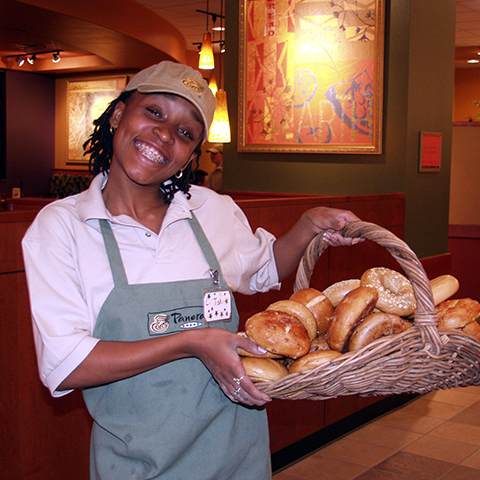
A useful comparison can be seen in Pret A Manger and Panera Bread, both are apex brands within their respective markets, admired for operational discipline and broad appeal. Yet their economic models reveal a fundamental divergence in how value is created. *Pret’s average unit sales are approximately £1.7 million, while Panera’s approach £2.4 million. However, Pret typically operates from units averaging around 230 square metres, compared with Panera’s average footprint of over 420 square metres. On a sales-per-square-foot basis, Pret generates roughly £680 per square foot versus Panera’s approximate $622, a meaningful differential when scaled across an estate.
*Source: Information taken from Pret a Manger & Panera Bread Websites
Strategic focus further differentiates the two. Pret elevated coffee to a core proposition early in its development, positioning it as a primary growth driver for frequency, margin and brand relevance. Panera, while offering coffee, never fully foregrounded it, underleveraging one of the most significant growth categories of the past two decades.
This contrast reflects a broader structural difference. US brands have historically succeeded by focusing on a single dominant hero category, supported by scale and space. UK brands, operating under tighter constraints, have been required to extract value from multiple hero categories simultaneously. The result is businesses that are more productive per square foot, more flexible and ultimately more resilient.
As US markets become denser and more cost-sensitive, this British model of precision and restraint is becoming increasingly relevant. The future will favour operators that can deliver more with less, not only in real estate terms, but in how menus, occasions and experiences are layered.
Health-Forward Without Compromising Enjoyment
 The UK has also progressed more rapidly towards health-adjacent indulgence. Plant-forward menus, lower alcohol consumption and functional ingredients are now mainstream expectations rather than niche propositions. Health has become a baseline rather than a category.
This is particularly evident in the growth of no and low-alcohol beverages. The UK has historically led adoption in this space, supported by an established “no/lo” culture and brands such as Seedlip. The US is now accelerating rapidly, with significant volume potential as consumer attitudes continue to evolve.
For operators, the opportunity lies not in removing indulgence, but in recalibrating it. Menus that balance pleasure with functional cues around energy, mood and wellbeing consistently achieve higher engagement and tolerance.
AI as a Management Layer
One of the most significant shifts facing operators in 2026 is the reframing of artificial intelligence.
A critical error in the field of AI is to treat it as a software upgrade rather than a fundamental operating layer. For example, traditional KPIs were built for hindsight. AI enables foresight. Leading operators are supplementing conventional [KPI] metrics with measures that capture elasticity, volatility and productivity in real time. Labour is assessed as a dynamic resource rather than a static percentage, while menus are evaluated for predictability and demand stability alongside margin.
The U.S. hospitality sector is leading AI adoption, with nearly 80% of restaurant operators already using or actively exploring AI-driven systems. While the UK is a globally recognized AI hub and shows strong intent to invest, its hospitality industry is still in the earlier stages of translating AI innovation into proven, large-scale operational value.
Competitive advantage will accrue not to the most technologically advanced operators, but to the most adaptable. As Charles Darwin once observed, it is adaptability, not strength or intelligence alone, that determines survival, a principle increasingly relevant to hospitality.
Trend Mapping in a Saturated Landscape
By 2026, trend fatigue is widespread. The winners are emerging as ‘trend mappers’, operators capable of distinguishing durable behavioural change from short-lived narratives.
Effective trend mapping asks disciplined questions: does this reflect genuine consumer behaviour? Can it scale without degrading quality? Does it enhance or erode consumer tolerance over time? Ghost kitchens, experiential dining and community-led independents each reveal different answers when examined through this lens.
Once again, a cross-Atlantic perspective is instructive. The UK offers authenticity and trust; the US provides systems and scalability. The most robust future brands will integrate both.
Labour, Real Estate and the Future Operating Model
Labour shortages are structural rather than cyclical. The future workforce prioritises predictability, development, simplicity and psychological safety. US operators lead in role simplification through technology, while UK operators excel in flexibility and multi-skilling. The next generation of hospitality businesses will combine both approaches, supported by AI-enabled scheduling and transparent progression pathways.
Real estate strategy is also evolving. Long leases increasingly represent strategic risk rather than security. Turnover-linked rents, multi-brand sites and pop-ups used as live testing environments are becoming core tools. The US contributes portfolio-level thinking; the UK contributes adaptive reuse. Together, they point towards flexibility as the new definition of prime.
The Hybrid Advantage
The most resilient foodservice brands of the next decade will not think in national terms. They will be hybrids: US-level systems paired with UK-level restraint; data-driven yet emotionally literate; operationally efficient without feeling corporate; health-aware without moralising.
Rather than prioritising expansion for its own sake, they will focus on relevance velocity, the ability to adapt quickly without losing brand identity.
Over the next decade, hospitality winners will not be the biggest brands, but the most precise.
The next era of foodservice will be defined by those who quietly build better, more resilient businesses. Cross-Atlantic learning is no longer optional; it is a competitive advantage. Operators willing to borrow intelligently, adapt selectively and challenge inherited assumptions will not only survive 2026 and beyond, they will shape it.
The future is already here. It is simply unevenly distributed.
Key Takeaways for British Brands Entering 2026
- Design for intensity, not expansion; revenue density will increasingly outweigh unit count.
- Deploy data in all operational intelligence, not just a marketing.
- Build multiple hero categories to maximise flexibility and resilience.
- Reframe KPIs for an AI-enabled, forward-looking operating environment.
- Treat efficiency as a brand asset that enhances, rather than detracts from, the guest experience.
Robert Ancill is Scottish-born, California-based restaurant consultant, brand strategist, and design innovator with more than 30 years of experience in the international hospitality
industry.