
The Strategic Discipline Driving Margin Expansion in 2026
 In today’s hospitality landscape, defined by compressed margins, dynamic pricing volatility, AI-powered forecasting, and increasingly sophisticated guests, your menu is no longer a static list of offerings. It is a strategic growth asset. For forward-thinking restaurant owners, hotel operators, and C-suite leaders, menu engineering has evolved from an operational exercise into a boardroom-level profitability strategy.
At its highest level, menu engineering is the deliberate integration of culinary vision, financial intelligence, behavioral psychology, and brand storytelling. It aligns contribution margin, guest preference data, and design science to create a menu that performs as hard as any executive on your leadership team. In a market where labor, food costs, and supply chain pressures remain volatile, disciplined and ongoing menu engineering can increase profitability by 10–15%, and in optimized environments, materially more.
In 2026, menu engineering is not optional. It is a core driver of revenue optimization and brand positioning.
What Menu Engineering Really Means
Menu engineering is the systematic evaluation of menu items based on two primary metrics, profitability and popularity, followed by intentional design and placement strategies that influence purchasing behavior. It is not simply about “what sells.” It is about what sells profitably, consistently, and in alignment with your brand narrative.
The discipline sits at the intersection of four executive priorities: financial performance, guest experience, operational efficiency, and strategic positioning. When executed properly, it transforms the menu into a precision-guided revenue engine.
At its core, menu engineering encompasses five fundamental capabilities: rigorous analysis of sales and cost data; strategic categorization of items; intentional placement within the visual architecture of the menu; psychologically informed design; and continuous optimization informed by real-time performance metrics.
Step One: Quantifying Profitability and Popularity
Every effective menu engineering initiative begins with financial clarity. The two metrics that matter most are Contribution Margin, defined as menu price minus food cost, and Sales Volume. Together, they reveal not just what guests love, but what your business should prioritize.
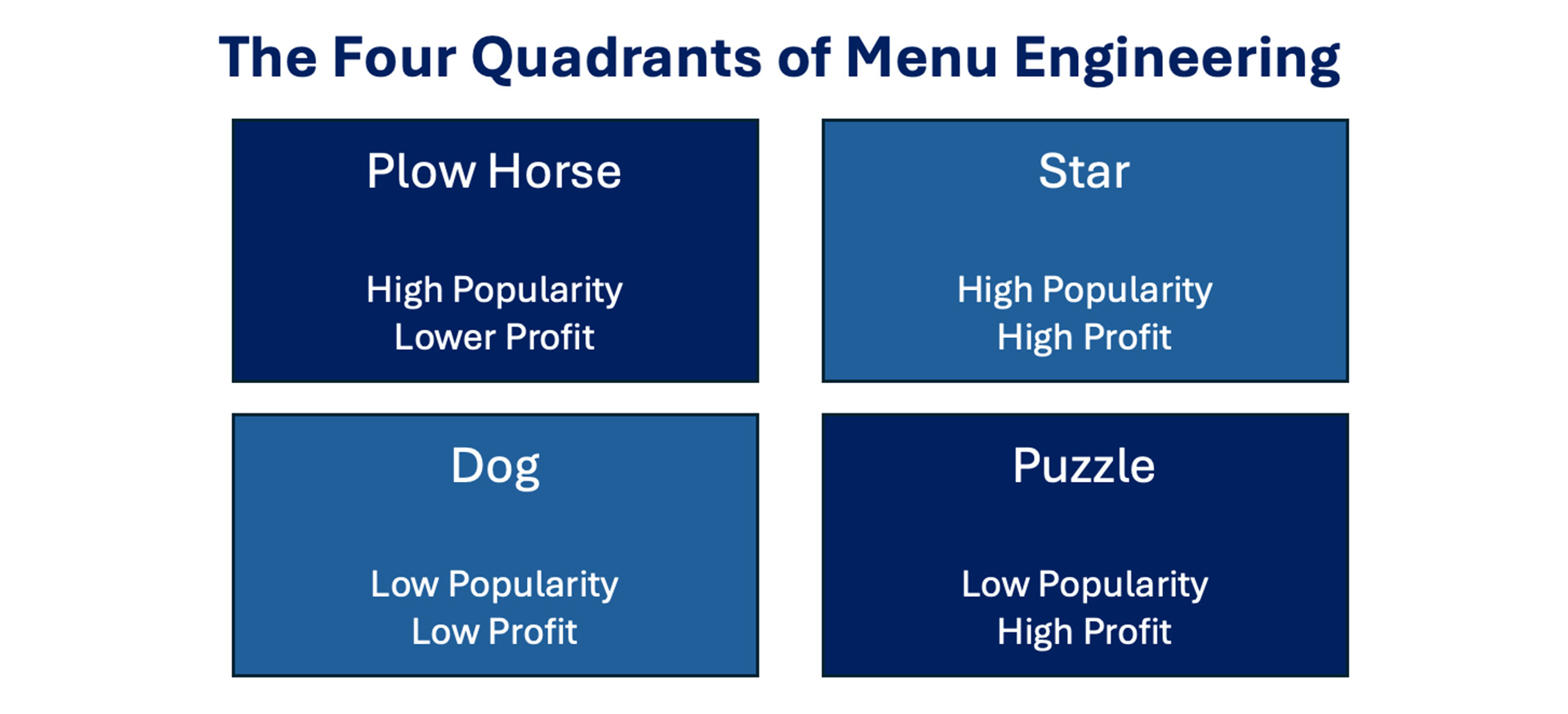
When plotted on a menu engineering matrix, items fall into four distinct performance categories.
Stars represent the ideal. These dishes generate high contribution margins and enjoy strong sales volume. They are operationally sound, financially accretive, and brand-enhancing. These are your signature items, the dishes that define your concept while strengthening EBITDA. In 2026, Stars should be protected, elevated, and amplified through strategic placement, premium storytelling, and omnichannel marketing integration.
Puzzles are high-margin but under-ordered. They are latent profit opportunities waiting for activation. Often the issue lies not in the product, but in positioning, uninspired descriptions, suboptimal placement, or price perception friction. With refined language, strategic highlighting, and tactical promotion, Puzzles can become Stars, unlocking incremental margin without increasing operational complexity.
Plowhorses are popular yet margin-thin. They drive traffic but strain profitability. The solution is not elimination, but optimization. Portion recalibration, ingredient substitution, bundling with high-margin add-ons, or premiumization through upgrades can rebalance their financial performance without alienating loyal guests.
Dogs underperform on both dimensions. In a modern portfolio mindset, these items represent opportunity cost. They consume inventory, training time, and menu real estate without contributing to enterprise value. Decisive operators either reposition them with strategic reinvention or remove them entirely, simplifying operations and improving overall mix.
This disciplined categorization alone frequently reveals margin leakage that has quietly accumulated over time. For multi-unit groups and hotel F&B portfolios, the impact can be substantial.
Step Two: Strategic Placement and Behavioral Architecture
 Menu layout is not aesthetic, it is behavioral architecture.
Eye-tracking studies consistently demonstrate predictable guest scanning patterns. The upper-right quadrant, often referred to as the “golden triangle,” commands disproportionate attention. In 2026, leading operators leverage this insight with precision.
High-margin Stars and optimized Puzzles deserve premium visual positioning. They should live in high-visibility zones, framed by thoughtful spacing, subtle callouts, or narrative headers such as “Chef’s Selection” or “Signature Experience.” The objective is not manipulation; it is intelligent guidance.
Equally important is restraint. Overemphasis creates noise. Sophisticated guests detect overt sales tactics. The most effective engineered menus feel intuitive, not engineered. They align storytelling, hierarchy, and whitespace to create a natural flow that guides decision-making without pressure.
In luxury and upscale environments, this becomes even more critical. Placement communicates value. Hierarchy signals importance. Your layout subtly tells the guest what matters most.
Step Three: Design Psychology and Revenue Influence
In an era of digital-first hospitality, the menu is both physical and virtual. Whether presented on linen-textured cardstock or within a QR-enabled dynamic interface, design choices influence purchasing behavior.
Strategic typography establishes hierarchy. Clean, legible fonts communicate confidence and modernity. Subtle size variations emphasize priority items without appearing promotional. Thoughtful whitespace enhances readability and elevates perceived quality.
Currency presentation also matters. Research continues to show that removing currency symbols reduces price salience and encourages higher spend. In 2026, many operators are also leveraging dynamic pricing models, adjusting pricing seasonally or even daily based on demand forecasting and cost inputs.
Imagery, when used, should be intentional and sparing. A single powerful visual can outperform multiple average ones. In premium environments, evocative descriptions often outperform photography, reinforcing brand sophistication.
Digital menus introduce additional optimization layers. Data capture, A/B testing of descriptions, real-time upsell prompts, and AI-driven recommendations are becoming part of advanced revenue management ecosystems. When integrated properly, digital menu engineering aligns seamlessly with POS analytics and demand forecasting platforms, creating a closed-loop optimization cycle.
Step Four: Continuous Optimization and Adaptive Strategy
Menu engineering is not a quarterly exercise, it is an ongoing strategic discipline.
Ingredient costs fluctuate. Consumer preferences evolve. Competitive landscapes shift. A menu engineered twelve months ago may already be leaking margin today.
High-performing operators review item-level performance regularly, often monthly. They monitor contribution margins, track sales mix shifts, and evaluate how promotional campaigns affect item migration between categories. They collaborate across finance, culinary, marketing, and operations to ensure alignment.
Frontline insights matter as well. Servers provide real-time intelligence on guest objections, substitutions, and trending preferences. When combined with POS analytics and supply chain data, these insights create a holistic decision framework.
This iterative process ensures your menu remains aligned with both market demand and enterprise profitability targets.
Why Menu Engineering Is a Strategic Imperative
For sophisticated operators and executive teams, the benefits extend far beyond incremental gains.
First, engineered menus drive measurable margin expansion. Eliminating underperformers, optimizing mix, and guiding guests toward high-contribution items can materially improve EBITDA without increasing traffic.
Second, they enhance the guest experience. A well-structured menu reduces cognitive overload. Guests feel guided, not overwhelmed. Decision-making becomes intuitive, increasing satisfaction and perceived value.
Third, menu engineering strengthens brand coherence. Your menu is one of the most powerful expressions of your positioning. Whether you operate a luxury hotel restaurant, a lifestyle-driven urban concept, or a high-volume premium casual brand, the engineered menu reinforces your narrative.
Finally, it fosters data-driven leadership. In 2026, intuition alone is insufficient. The most successful operators combine culinary creativity with predictive analytics, turning data into competitive advantage.
It is no surprise that disciplined menu engineering has been a hospitality best practice for over three decades. Industry leaders, including Robert Ancill, have documented revenue and profitability increases exceeding 25% when menu engineering is executed comprehensively and consistently.
The Menu as a Revenue Engine
Your menu is not a static artifact, it is a dynamic performance tool. It influences guest perception, average check, operational complexity, and ultimately enterprise value.
For owners, CEOs, COOs, and CMOs navigating today’s hospitality economy, menu engineering represents one of the highest-ROI initiatives available. It requires no new location, no additional square footage, and no capital-intensive buildout. It requires discipline, analysis, and strategic intent.
When profitability metrics, behavioral design, and brand storytelling align, your menu begins to work with precision. It guides decisions. It elevates experience. It expands margins.
The question is no longer whether to engineer your menu. The question is whether your current menu is working as hard as it should.
The operators who treat their menu as a strategic asset, continuously analyzed, optimized, and refined, are the ones who will lead the next era of hospitality performance.