
Restaurant Technology Consulting
Building Restaurant Technology Around the Operation, Not the Other Way Around
Restaurant technology has moved far beyond the point-of-sale system. Today, a restaurant may rely on twenty or more interconnected technologies to take an order, process a payment, route production, schedule employees, manage recipes, monitor inventory, communicate with guests, administer loyalty programs, process delivery orders, measure performance and provide management with meaningful information.
The problem is rarely a lack of technology. More often, restaurants have too much technology, poorly connected technology, duplicated technology or systems that were selected independently without considering how the complete restaurant operation actually works.
TNI Restaurant Consultants approaches restaurant technology differently. We begin with the operation. We examine how guests order, how employees work, how food moves through the kitchen, how managers make decisions, where labor is being consumed, where information is duplicated, where errors occur and where friction exists. Only then do we determine what technology should support the business.
The objective is not to create the restaurant with the most technology. It is to create the restaurant in which technology produces the greatest operational and commercial return.
Restaurant Technology Strategy
Restaurant technology should operate as an ecosystem rather than a collection of applications.
The POS may connect with the kitchen display system. The POS and purchasing system should inform inventory. Inventory should connect with recipes and theoretical food cost. Labor scheduling should respond to forecast sales. Loyalty and CRM should connect transactions with identifiable customers. Digital ordering should feed the same operational infrastructure rather than creating another isolated channel.
When those connections work, technology becomes an operating system for the restaurant. When they do not, managers frequently find themselves moving information between systems, reconciling conflicting reports and maintaining expensive applications that solve individual problems while creating new ones elsewhere. TNI helps restaurant operators, hospitality companies, franchise systems and emerging restaurant concepts develop a coherent restaurant technology strategy around the requirements of the business.
Our work includes technology audits, technology stack development, vendor evaluation, system selection, integration planning, implementation strategy, operational workflow design and technology ROI analysis.
Restaurant Technology Stack Audits
One of the most valuable technology exercises a restaurant company can undertake is often not purchasing another system. It is understanding the systems it already has. TNI conducts restaurant technology stack audits to identify what technology is being used, what it costs, what it does, where functionality overlaps and where important operational gaps remain.
We examine the relationship between POS, payments, KDS, inventory, purchasing, accounting, workforce management, reservations, loyalty, CRM, online ordering, delivery platforms, training systems, reporting and other restaurant software. The result is a clearer picture of the restaurant's technology architecture and an opportunity to simplify it.
In some cases, the recommendation may be additional technology. In others, the better answer may be consolidation, improved integration or removing systems that no longer create sufficient value.
POS System Selection and Optimization
The restaurant POS system remains one of the most important components of the restaurant technology stack, but selecting a POS based purely on features can be a costly mistake.
Different restaurant models require very different capabilities.
A fast-casual restaurant processing significant kiosk and digital volume has different requirements from a fine-dining restaurant managing reservations and complex table service. A multi-unit franchise system needs capabilities that may be unnecessary for an independent restaurant.
TNI evaluates POS systems against the actual restaurant model, including ordering architecture, menu complexity, payment processing, integrations, reporting, loyalty, delivery, online ordering, kitchen communication, scalability, support and total cost of ownership.
Where an existing POS is underperforming, we can also evaluate whether the underlying problem is the platform itself or how it has been configured and integrated.
Kitchen Display Systems and Kitchen Technology
Restaurant technology should not stop at the kitchen door.
Kitchen Display Systems, production routing, make-line technology, order sequencing, timers and operational analytics can significantly influence throughput and order accuracy when they are properly configured.
TNI evaluates kitchen technology as part of the overall production system. That means looking beyond screens and software to understand station design, menu complexity, production sequence, equipment positioning, staffing, ticket flow and peak-period capacity. A poorly designed production system cannot necessarily be repaired by installing more technology. Technology and operational design have to work together.
Digital Ordering, Kiosks and Self-Service Technology
The ordering journey has fragmented.
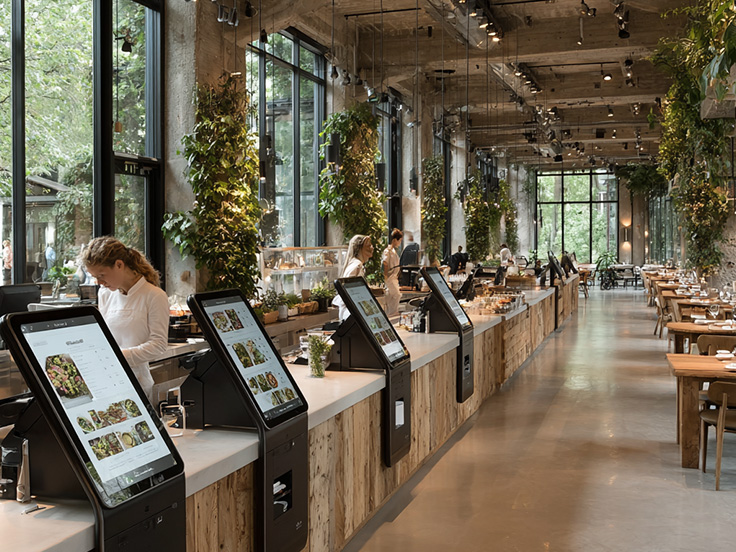
Guests may now order through a cashier, server, handheld device, QR code, website, mobile application, kiosk, drive-thru, delivery marketplace or third-party platform.
Each additional channel can create convenience for the customer while adding complexity behind the counter. TNI helps restaurant operators determine where digital ordering and self-service technology genuinely improves the guest journey and where it simply transfers friction from one part of the operation to another. Our analysis considers ordering speed, menu navigation, upselling, average check, payment, accessibility, kitchen capacity, labor deployment, queue management and the relationship between digital and human service. The objective is not automation for its own sake. It is a better transaction for both the customer and the restaurant.
Artificial Intelligence in Restaurants
Artificial intelligence is rapidly entering restaurant operations, but the opportunity extends well beyond generative AI.
AI can increasingly support forecasting, scheduling, purchasing, inventory management, menu analysis, customer communication, marketing, recruitment, training, ordering and performance analytics.
The commercial question is where AI creates measurable value. TNI helps restaurant companies identify practical AI applications while distinguishing meaningful operational opportunities from technology that is interesting but commercially premature. We examine the task being automated, the quality of available data, integration requirements, management oversight, implementation cost and likely return. AI should remove low-value administrative work, improve decisions or reduce friction; if it does none of those things, its strategic value is questionable.
Restaurant Robotics and Automation
Robotics has become one of the most visible areas of restaurant innovation, but successful restaurant automation requires considerably more analysis than choosing a robot.
TNI evaluates robotics through the lens of workflow and economics. Applications may include food preparation, beverage production, frying, cooking, food running, bussing, cleaning, warehousing and other repetitive restaurant tasks. We assess whether automation can realistically improve throughput, consistency, safety, labor productivity or guest experience. We can assist with vendor evaluation, workflow planning, integration and implementation, together with assessment of capital cost and expected return.
In some operations robotics can materially improve productivity, in others, a simpler operational redesign may produce a better return. Knowing the difference is part of the consulting process.
Inventory, Purchasing and Food Cost Technology
Food cost cannot be effectively managed by looking at a monthly P&L after the money has already been spent.
Modern restaurant inventory and purchasing systems can connect recipes, purchasing, vendor pricing, inventory, sales mix and waste to create a much clearer picture of what is happening inside the operation. TNI helps operators evaluate and implement systems that can support recipe costing, theoretical versus actual food cost, purchasing, invoice processing, inventory counts, waste tracking and vendor management. The objective is not simply better inventory counts. It is better cost intelligence.
Labor Management, Scheduling and Workforce Technology
Labor represents one of the largest controllable expenses in a restaurant, making workforce technology an increasingly important component of the restaurant operating system.
Scheduling platforms can help operators forecast demand, build schedules, monitor hours, manage availability and identify potential overtime before it occurs. However software alone does not create labor productivity. TNI combines workforce technology with operational analysis to examine deployment, station productivity, opening and closing routines, production requirements and sales patterns.
The question is not simply whether the restaurant is scheduling fewer hours. It is whether the right labor is being deployed at the right time to support demand without damaging service.
CRM, Loyalty and Restaurant Customer Data
One of the most valuable assets in a restaurant may be information about its customers, yet many restaurant companies know surprisingly little about the people buying from them. An integrated restaurant CRM and loyalty strategy can connect transactional information with customer behavior, allowing operators to better understand frequency, preferences, purchasing patterns and engagement.
TNI evaluates loyalty platforms, CRM systems and customer-data strategies in the context of the broader restaurant technology stack. The opportunity is larger than points and rewards. Customer data can support segmentation, personalization, retention, targeted offers, menu development and more intelligent restaurant marketing.
Reservations, Waitlists and Guest Management
For full-service restaurants, reservation and guest-management technology has evolved into an important customer intelligence platform.
The right system can help manage reservations, waitlists, table utilization, guest history, preferences and communication while providing valuable information about demand patterns. TNI evaluates these platforms not simply as booking systems but as components of the guest journey and restaurant revenue model.
Delivery and Third-Party Technology
Off-premise restaurant sales have created another technology layer for operators. Third-party delivery platforms, direct ordering systems, delivery aggregators and middleware can increase restaurant reach while simultaneously introducing commissions, operational complexity and fragmented customer data. TNI helps restaurant operators evaluate the economics and operational impact of delivery technology, including channel strategy, menu configuration, kitchen integration, pricing, order aggregation and the relationship between third-party and direct ordering.
Restaurant Data Analytics and Corporate Reporting
Restaurants generate enormous quantities of information. The challenge is turning that information into decisions. TNI helps multi-unit restaurant groups, franchise systems and independent operators develop reporting structures that convert restaurant data into meaningful management intelligence.
Depending upon the operation, this can include sales, transactions, average check, labor, food cost, waste, inventory, discounts, voids, channel mix, daypart performance, menu mix and location-level comparisons. For multi-unit companies, the objective is particularly important: create a consistent view of performance across the enterprise without forcing management teams to manually assemble information from multiple systems. A useful dashboard should not simply describe what happened. It should help management understand where attention is required.
Technology for New Restaurant Concepts
Technology decisions made during restaurant development can have consequences for years. TNI can develop the restaurant technology strategy alongside concept development, operational planning and restaurant design, allowing technology requirements to be considered before construction and opening. This can include POS, networking, Wi-Fi, KDS, digital menu boards, kiosks, handheld devices, payment terminals, printers, audio-visual systems, security interfaces, back-office hardware and technology infrastructure. Planning early can reduce expensive retrofits and help ensure that the physical restaurant supports the intended operating model.
Technology for Restaurant Groups and Franchise Systems
As restaurant companies scale, technology decisions become increasingly strategic; a system that works effectively in three restaurants may become difficult to administer across thirty or three hundred. TNI helps restaurant groups and franchise organizations evaluate technology through the additional requirements of standardization, scalability, permissions, reporting, franchisee adoption, training, support and implementation.
The goal is to create a technology architecture that can grow with the brand rather than requiring repeated replacement as the company expands.
Technology Should Reduce Friction
At TNI Restaurant Consultants, we do not begin with the assumption that every restaurant needs more technology.
Sometimes it does, sometimes it needs fewer systems, better integrations, better configuration or better management information, and sometimes the problem being blamed on technology is actually an operational problem. Our role is to distinguish between them. We combine restaurant operations, technology strategy and commercial analysis to help operators determine what technology belongs in their business, what does not and how the complete ecosystem should work together.
Because ultimately, restaurant technology should accomplish something remarkably simple; it should make the restaurant easier to operate, easier to manage and easier for the customer to use.
Restaurant Technology Consulting Services
TNI Restaurant Consultants can support restaurant operators with POS system selection and optimization, restaurant technology stack audits, kitchen display systems, restaurant AI strategy, robotics and automation, kiosks and self-ordering, digital ordering, inventory management systems, recipe and food-cost technology, workforce management and scheduling, CRM and loyalty platforms, reservation and guest-management systems, delivery technology, restaurant data analytics, corporate reporting, technology vendor evaluation, system integration strategy, new restaurant technology planning and multi-unit or franchise technology strategy.
Frequently Asked Questions
A restaurant technology consultant evaluates how technology can improve restaurant operations, guest experience, productivity, cost control and management information. This may include POS systems, KDS, inventory, scheduling, digital ordering, AI, robotics, CRM, loyalty and reporting systems.
Yes. A technology stack audit can examine existing platforms, integrations, costs, duplicated functionality, operational gaps and opportunities for consolidation or improvement.
TNI can evaluate POS platforms against the requirements of the restaurant rather than simply comparing feature lists. Considerations can include concept type, ordering channels, integrations, payments, reporting, kitchen requirements, scalability and total cost of ownership.
Yes. TNI can identify practical restaurant AI applications and evaluate them against operational requirements, integration complexity, cost and potential return.
Yes. TNI evaluates restaurant robotics and automation from an operational and financial perspective, including potential applications, workflow implications, vendor selection and ROI.
Technology can improve labor productivity through better forecasting, scheduling, ordering, production and automation. The result depends upon how the technology is integrated with the restaurant’s operating model.
Yes. TNI can develop technology strategies for restaurant groups and franchise systems, including standardized platforms, reporting, scalability and location-level implementation.
Yes. TNI can evaluate inventory, purchasing, recipe costing, invoice processing, waste and food-cost management technologies and how those systems integrate with POS and accounting platforms.
Yes. TNI evaluates kiosks, mobile ordering, online ordering and other self-service technologies in relation to customer experience, throughput, labor, menu architecture and kitchen capacity.
Ideally, restaurant technology planning should begin during concept and operational development rather than immediately before opening. Early planning allows infrastructure, electrical, data, equipment, counter design and kitchen workflow requirements to be coordinated with the restaurant design.
Not necessarily. In many cases the opportunity lies in integrating existing technology, eliminating duplicated systems or improving operating processes. The appropriate solution depends upon the underlying cause of the problem.
Restaurant technology ROI should consider more than software cost. Depending on the application, measurements may include labor productivity, transaction time, throughput, order accuracy, food cost, waste, average check, guest frequency, management time and incremental revenue.
Technology With a Commercial Purpose
Restaurant technology is evolving quickly. The fundamentals of hospitality are not.
The strongest technology strategy connects the two.
TNI Restaurant Consultants helps restaurant operators, developers, franchise companies and hospitality organizations build technology ecosystems around the commercial realities of their businesses, combining operational experience with emerging technology to improve productivity, visibility, scalability and the guest experience.
The question is no longer simply, “What restaurant technology should we buy?”
The more valuable question is, “What should this restaurant be capable of doing, and what technology will help us do it better?”